Showing posts with label Platformer. Show all posts

Wednesday, October 2, 2019

CrossCode (PC): The MMO I always wanted.

Despite what people a number of people feel about them as a gaming news site, I read a fair bit of Kotaku in my day to day life. Mainly because of a few select writers who I enjoy the work of and have some pretty similar interests as far as games go. One of those writers is Mike Fahey, and in his write up at the end of last year he listed his top ten games of 2018.

One of them, I had never heard of before. Wasn't even remotely on my radar. Had nice looking pixel graphics, and boasted itself as an MMO that's really not. Strange, I thought, but ultimately clicked away. But then I started to see the title popping up in some other sites top 10 lists. Now that had my attention. How can a game that appears on so many people's best of lists get by me? Well, that merited a deeper look.

CROSSCODE (STEAM)

Image result for Crosscode

CrossCode opens with us in control of a dark haired woman racing through a dark foresty area. She is on the hunt for her brother, and shadowy voice implores her to stop. She vehemently denies, saying that she is trying to stop her brother from working to death. The voice spawns monsters to stop her which the girl quickly dispatches. After tearing through the enemies put before her, she does find her brother just to see him collapse from exhaustion.

We are woken up in a different location. Our hair and outfit are slightly different. An operator tells us that our name is Lea, and we are actually logged into an avatar of the futuristic MMO called CrossWorlds. In the vein of Sword Art Online, Crossworlds is a game where the players are actually implanted in the game to a heavy degree of the 5 senses. Unfortunately, we are told there has been an accident and that we are in a coma in the real world, and we are being placed into the game to try to find out what happened.

To make matters worse though, our speech unit is damaged. We can understand fine, and give minor visual responses but we are told that in order to solve this issue and hopefully find some answers, we need to play the game just as if we were any other player in the game. Lea remembers the basics of how to use her Spheromancer class in the game and after running into a friendly Pentafist named Emilie in the rookie island, she and her new friend jump into the game of Crossworlds to hopefully learn what's happened to her.

Loaded for bear

CrossCode is going to be an interesting game to try to review because the mechanics of this game borrow from so many different various elements that it doesn't really fall into just one genre of game. For example like I explained that the Lea is logged into an MMO, but you would incorrect to assume that's what this game actually is. The MMO aspect of the game is used as a framework for the story and the world.

What I mean be that is, yeah there is some questing that is done in the style of an MMO. You need to go talk to NPCs who give you quests to do, and you'll go into the world and fight mobs to collect items or kill a certain amount of enemies. As you wander around the world you'll see other players just running around, fighting their own things, or just hanging out. All of these are computer controlled. This is a fully single player experience, but it does a very good job of presenting the illusion that this is a living world with other players doing their own thing. 

When I describe the game, I describe along the lines of a 16-bit Zelda game such as A Link to the Past.  It's stylized in a way that it would look at home on the Super Nintendo with a top down view of the world, primarily a 2d play, but there is some degree of verticality to the maps which allows for some platforming and parkour when wandering around the world.
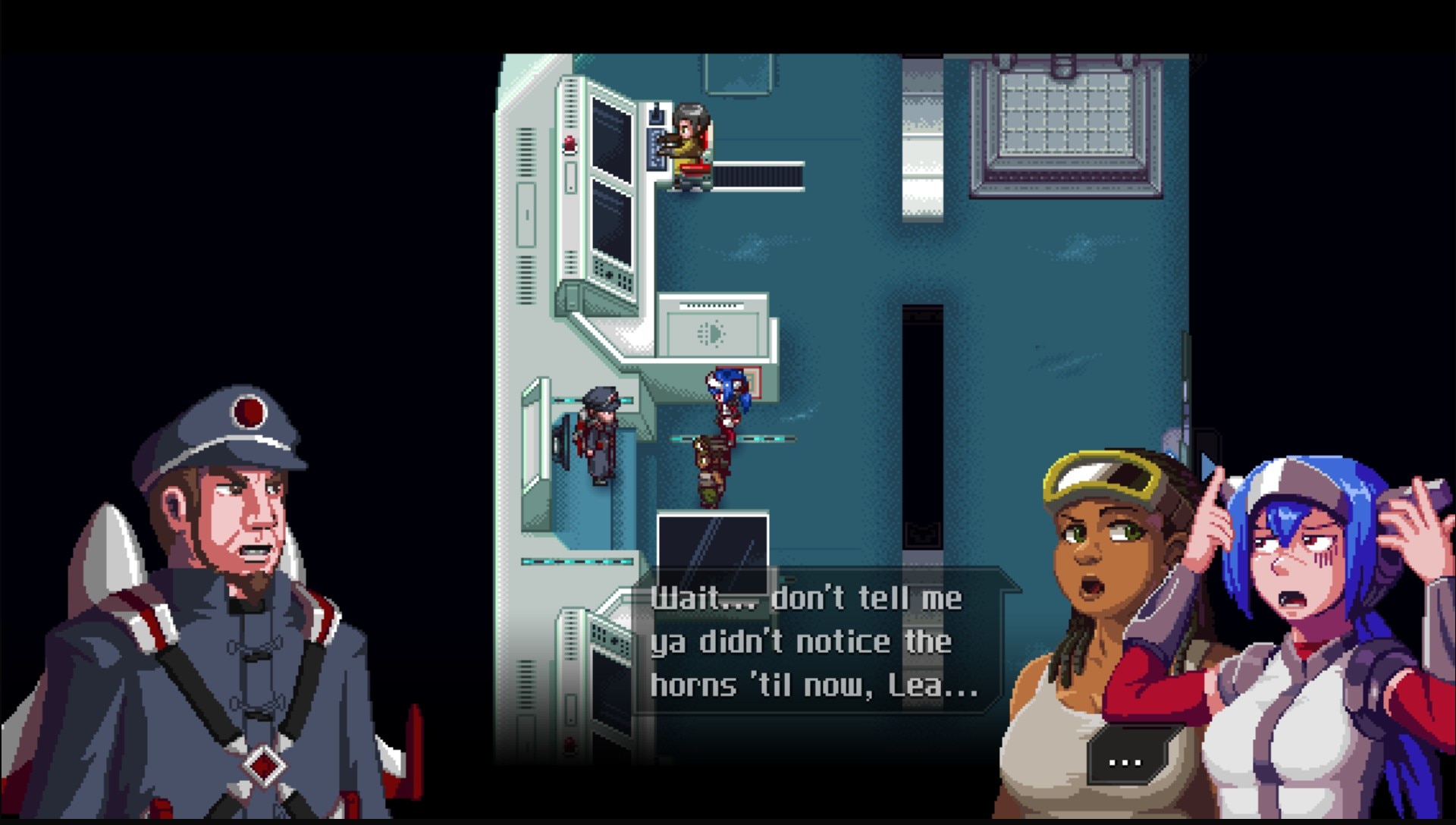

The combat is going to be the real meat and potatoes of this game. It's core is a hack and slasher with bit of Souls to it. You can run around and slash with a couple of swings with a single button press, you have a block that pulls up a shield and can parry if timed correctly, and you have a dodge move that has some invulnerability frames that lets Lea gracefully spin from harms way, which she can do up to the three times. 

But it she wouldn't be a Spheromancer without some spheres, and that's where her ranged attacks come in. When using the right analog (or I assume mouse on PC) the combat becomes almost a twin stick shooter. Holding a direction will bring a pair of lines for Lea's aim together, and once lined up you can unload a continue stream of projectiles at an enemy, which is handy for fast or flying foes. You can also charge up your first shot to ricochet off walls or break enemy guards.

As you play through the game and unlock your circuit board, you open your skill tree which allows you to learn multiple techniques for special moves for your Melee, Ranged, Dash and Shield. What is nice about this is as when you commit to an ability path, once you fill out the 3 spaces for it you can actually flip between your options so if you don't care for how one ability plays you can try the other option to see what works for you better. Even further in the game you start unlocking elemental grids which provide you with even more options to fight with, so you do have a bit of freedom to design your character.

Having familiarity with your Techs will let you set up the right attacks for them

Now while I've gone into the specifics of the combat and referred to it as the meat and potatoes of the game, it would actually be pretty foolish to assume the game is just battling. That's what I did and I was promptly set up for some gameplay whiplash. As you play through the "story" for Crossworlds you come onto these "instanced" dungeons where you have to go without your party. And while these do contain a significant number of fights usually capped off with a spectacular boss fight, you learn that CrossCode is in fact a serious puzzle game as well.

Actually, when thinking about it, this game might actually be more of a platform puzzler than it is an action adventure because depending on the size of your giant space brain, the puzzles can be a major stumbling block. I am more than man enough to admit that there were a number of that I had to look up a solution for because I just was not seeing it on my own.
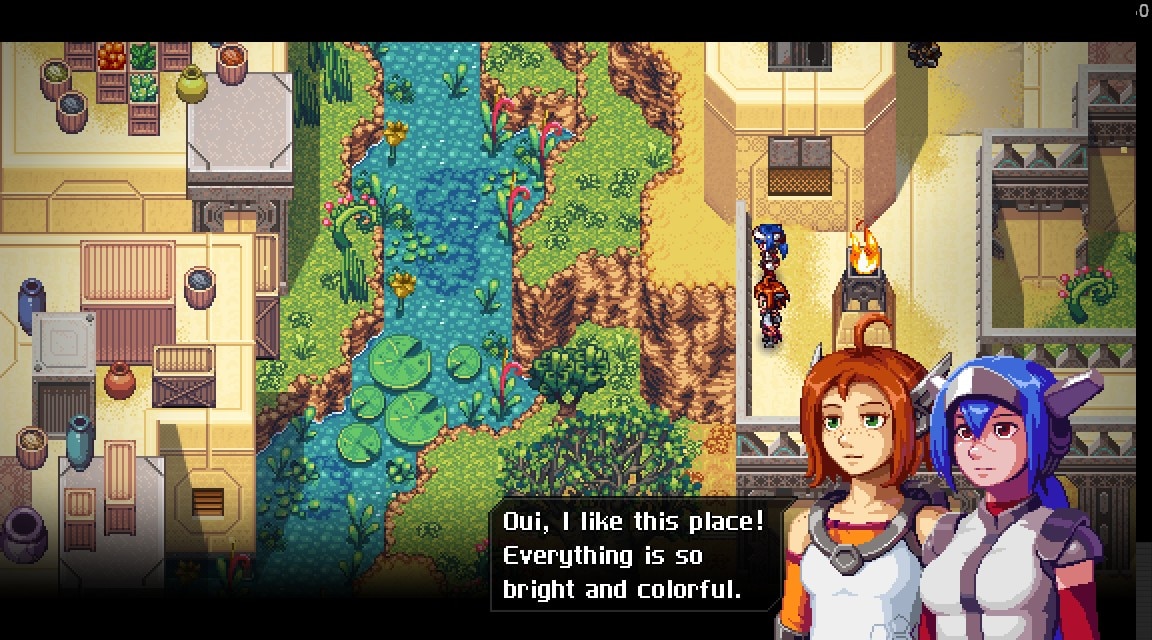
I love Emilie. She is just the right level of earnestness and naivety to make her impossible to hate.
Might be one of my favorite iterations of the best friend character. 

Sometimes the puzzles are just a matter of following the right path, and parkouring off the right environment pieces to get you from A to B. Sometimes the solution will require you moving around bits of your environment so that you can fire a projectile in the proper path to hit all the necessary points before coming on a final switch. Sometimes you will have to use the temples element for an environmental variant to the puzzles.

All I can say is some these will TEST you. Which can be frustrating because the story frames solving these dungeons like races against your friends. Like I said, I got stuck a lot. It wasn't until a friendly fan of the game in my Twitch chat told me to use visual cues on the floors of the puzzles to get a better idea of how to solve some these. It really did help a bit, but sometimes you can forget early mechanics that if you didn't use, would make the puzzle unsolvable, like remembering you can hop on fences.

So close, yet so far away

Outside from the puzzles, the actual combat can be very challenging as well. A lot of the enemies that you come across have their own unique weaknesses and patterns, so very rarely is just running and slashing away going to be the best way to dispatch something. It can work, but not always well. Then you have to bear in mind unless you use limited items to recover health, it doesn't restore until you finish fighting your combo chain. The more you beat enemies, the more valuable drops they give you, so its beneficial to beat a long string of baddies, but you have to be careful to mind your health.

To the CrossCode's credit, the options provide a very significant amount of customization to the overall game. Right from the onset, you are warned by the developers that this game meant to be a challenge, but if it's proving so difficult that you are not having any fun, you have options to bring down the battle and puzzle difficulties. It's a nice gesture and it gives the "git gud" scrubs less of an opportunity to be so insufferably smug when someone is struggling.

In addition to learning attack patterns and elements, you have to be mindful of ledges too.

CrossCode was a very weird game for me, because it was a game that I kept putting down. It's not because of a lack of interest of will, it is just a game that constantly got caught up in a retail release schedule as I played my games through the year. But there is something so inherently charming about it's whole presentation that always kept it in my mind. When I was playing something major like Red Dead Redemption 2, I always kept thinking "Soon as I finish this, I can get back to CrossCode".

It's story is interesting because it deals with a lot of fronts. First we have Lea's primary story, which is about her trying to figure out what happened to her. This is expounded to her by a character who is developer to the game, basically speaking to her directly. Then we have the Crossworld's "story mode" which is what we learn as Lea plays through the game with the friends she meets, and her interactions with those characters. Then we also have the front of what Crossworld's actually is, which we had a glimpse of at the start of the game and is told in flashback sequences. There is a lot to take in, but it does eventually tie together, (mostly. I'll get into that).

The game also has a sense of humor about itself. Lea, despite being a generally mute character is a very expressive character. She responds with overblown physical comedy and it really goes a long way to accentuate her personality depending on the scene. It also works for scenes when Lea was visibly emotionally shaken. Radicalfish games did an excellent job of finding a way to make you empathize with a silent protagonist.
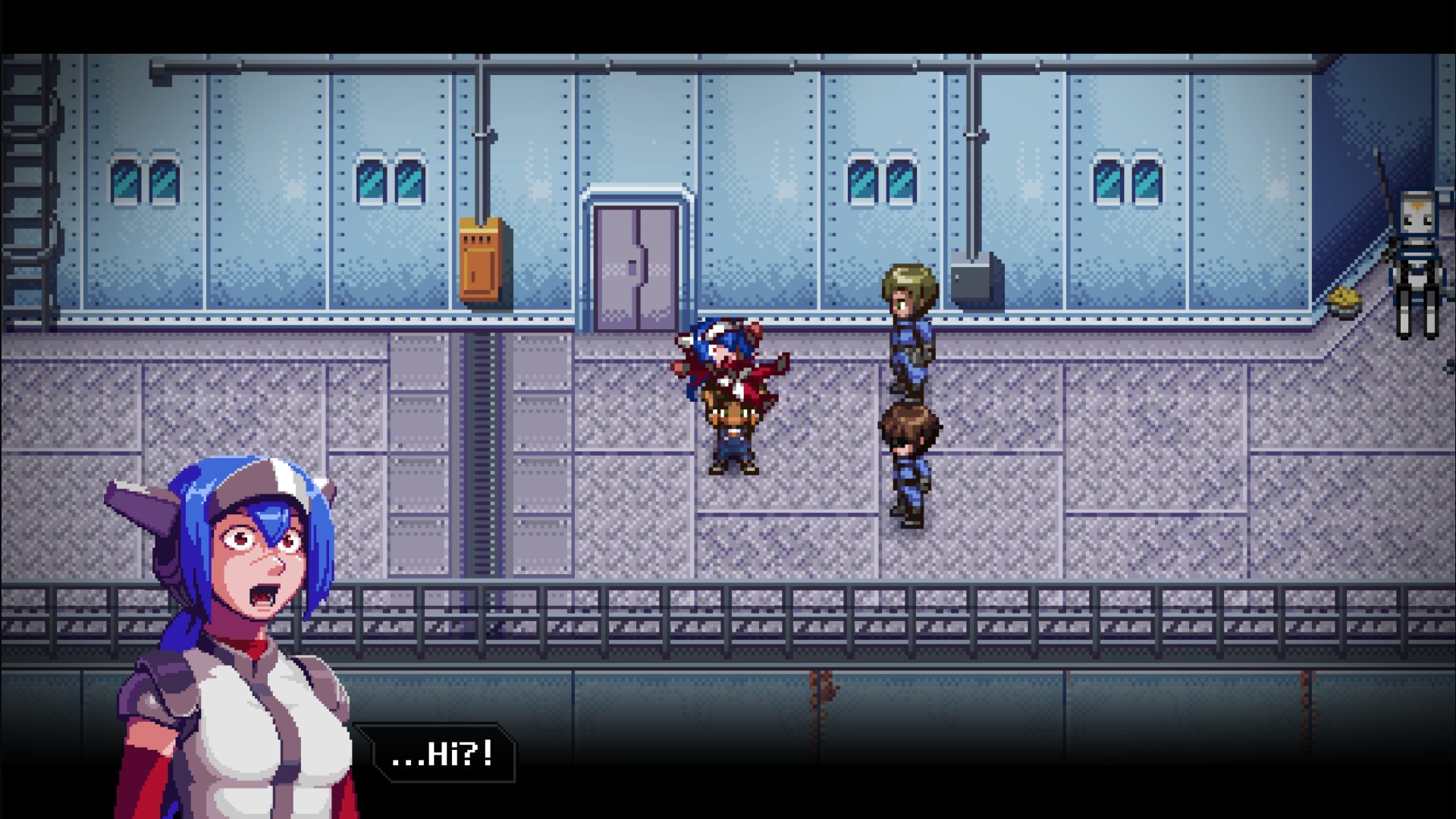

And man, CrossCode LOVES pop culture references. I basically freaked out when in the very beginning the game when one of the first npc quests parted me by saying Aziz Ansari's big line from the "Steak Night" episode of Scrubs. You find an "Umbrella corp." in one of the cities and you can't enter because of an outbreak they are having. For the Halloween event, you have to collect "Jack's flames" for a character that is CLEARLY Oogie Boogie from Nightmare Before Christmas. I can see from the coming update that there are more character references to be made soon.

Soundtrack is pretty good and it was very fitting for it's overall theme. Described by it's composer of Deniz Akbulut, the CrossCode OST is heavily inspired by Japanese game music of the late 90s using electronic beats, melodic tunes and epic JRPG Scores. This is a fair way to explain it, because the best description I had for it was "Video Gamey" which again, is perfect for it in this case because of the visual styling, story delivery, and accompanying gameplay. There are handful of decent tracks, but I wouldn't consider too many of the 60 to be overly memorable.
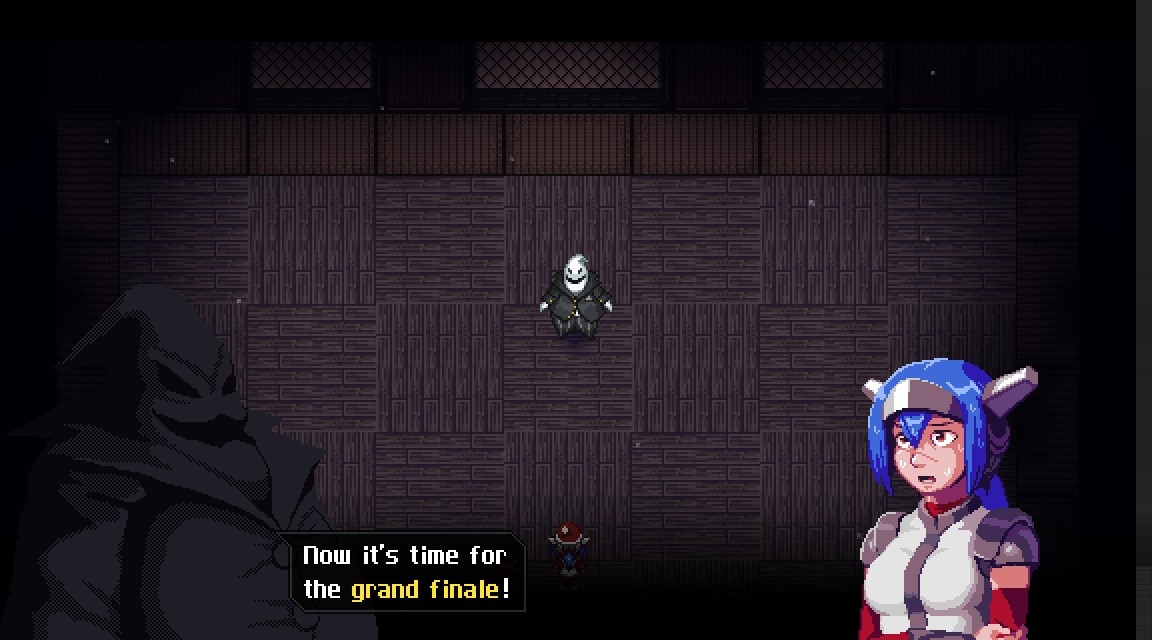
Oh Look. Its Doogie Noogie from A Bad Dream Before Kwanzaa. 
There really isn't a lot I have to complain about on this one that isn't in some way addressed. Like for example, when I complain about this game, I would often comment that these puzzles really do make me feel dumb as hell. It was very rare occurrence that I ever jumped into a room, saw the puzzle, and figured it out at a pretty quick clip. Now you can argue that having a solution guide embedded into the floor design is technically good game design, but there was very little indicating that's what they were doing. There was too little visual cue because I pretty much never noticed it until it was pointed out to me.

I could complain about the combat challenge, but I can only think of one real instance where I actually had to turn the difficulty down on a mob fight just so I could actually complete the quest. there was a pretty significant amount of frustration and trial & error, but outside of the one instance there was no fight that I wasn't eventually able to overcome under my own skill level.

Because the game is framed like an MMO, I could complain that some of the questing is the same MMO grind that bores me when I try to play a game like that, but it didn't bother me in this one. This is probably because the game is not an MMO. There is a story at play here with a defined ending, and because I'm not just killing mobs to open the next mission, I am motivated to continue because I want to see how things unfold.

I loved lightning techs, I used them almost exclusively because I love rapid fire damage.

And without spoiling anything? The ending feels unfinished. I get that this was a kickstarter game and they were probably trying to make a deadline to appease their backers, but it was a mild let down. In my first playthough I got a bad, pretty unsatisfying ending. I come to find out that you have to find a very out of the way NPC to trigger a small quest line which slightly changes the ending, but allows you to open the path to good ending.

Thankfully I could reload my save, so I did so. The ending changed by a few lines and actions, and just as I got ready to proceed further and see where it was going?  Nothing. I was able to go back into my game and do missed quests, but the option to go "to the future" was locked off, because that content isn't there yet. Or at least, it's heavily implied that the content will be added later. So I don't get to see how the story actually ends, and the dangling plot threads are left untied. Ironically, the NPC players are suffering from the same fate, because when you get to Crossworld's final dungeon, they players are all lamenting that it hasn't been included in the game yet. Misery loves company I guess.
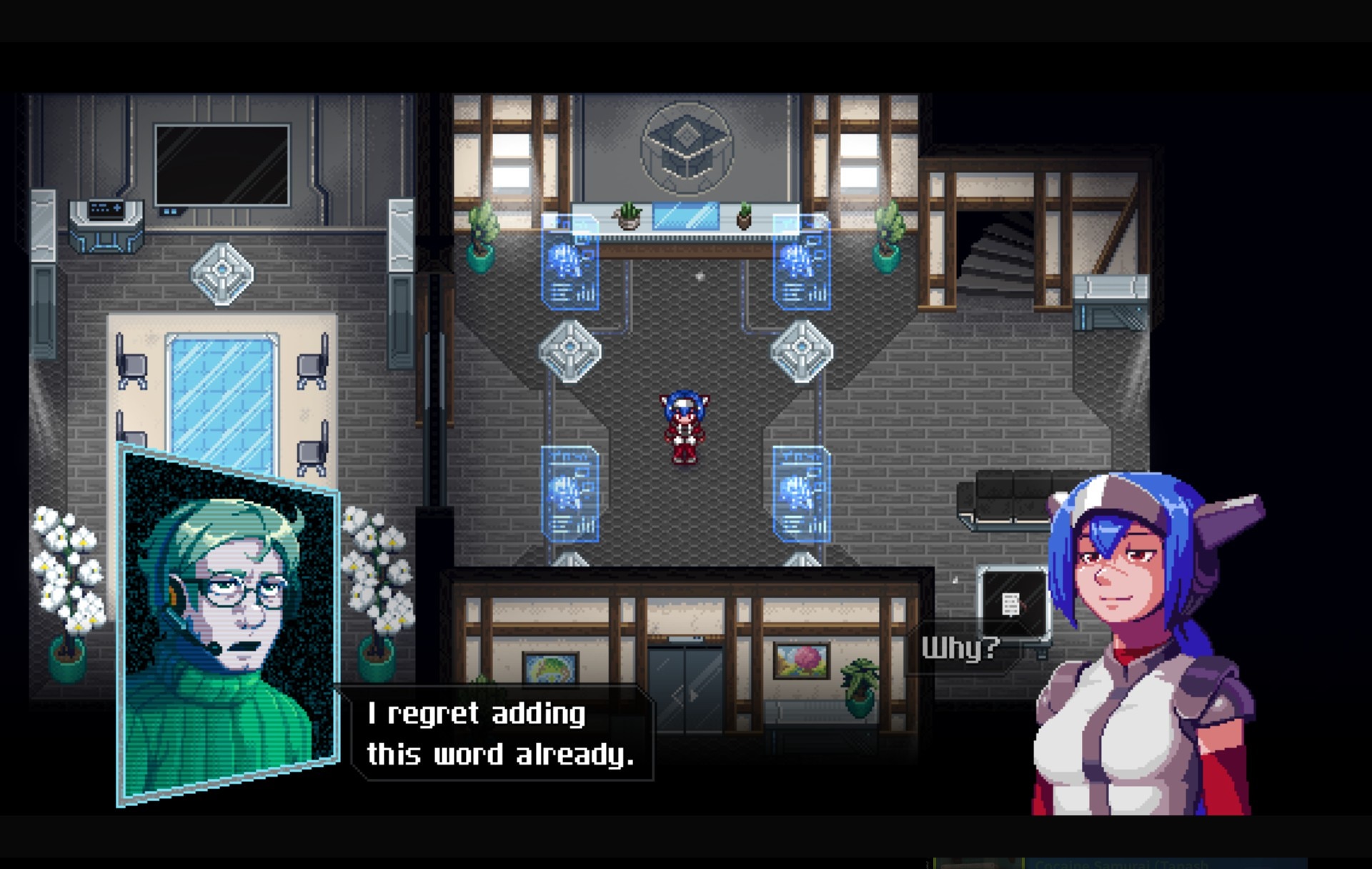
Smug Lea is best Lea.

But my biggest problem is the confusing and somewhat annoying equipment system. See, you an buy equipment in towns, and that is usually enough to keep your gear leveled with you and the area, and that's fine. But you are told that getting item drops to trade for equipment is usually better. This is where the fight combo chain thing I mentioned earlier comes in. But even if you get your combo chain to S-rank and hold it for a long while, it still takes quite a bit of time to get the drops you need for some items. Almost 90% of the time by the time I got the drops I needed for an item it was already outclassed by the new stuff I bought,.

Or, more frustratingly, when it wasn't? It didn't seem like the equipment is actually better. This is a game that has a friggen ton of various bonus effects to each item, so its incredibly hard to outfit your character. It feels like its giving you a lot of room for customization with items, but its so convoluted and confusing I never know if I'm making the right move. Like say I have a weapon that gives me decent stats, but has no effects. Then I find a "better" weapon, it has a brawler stat, and has a status effect, but then it gives me a massive ding to my HP and attack. I'm being told that this is the better weapon, but it never feels like it because they are unbalanced by what is taken away. It was frustrating because it made trying to grind for items feel like an arduous chore that wasn't worth the effort.
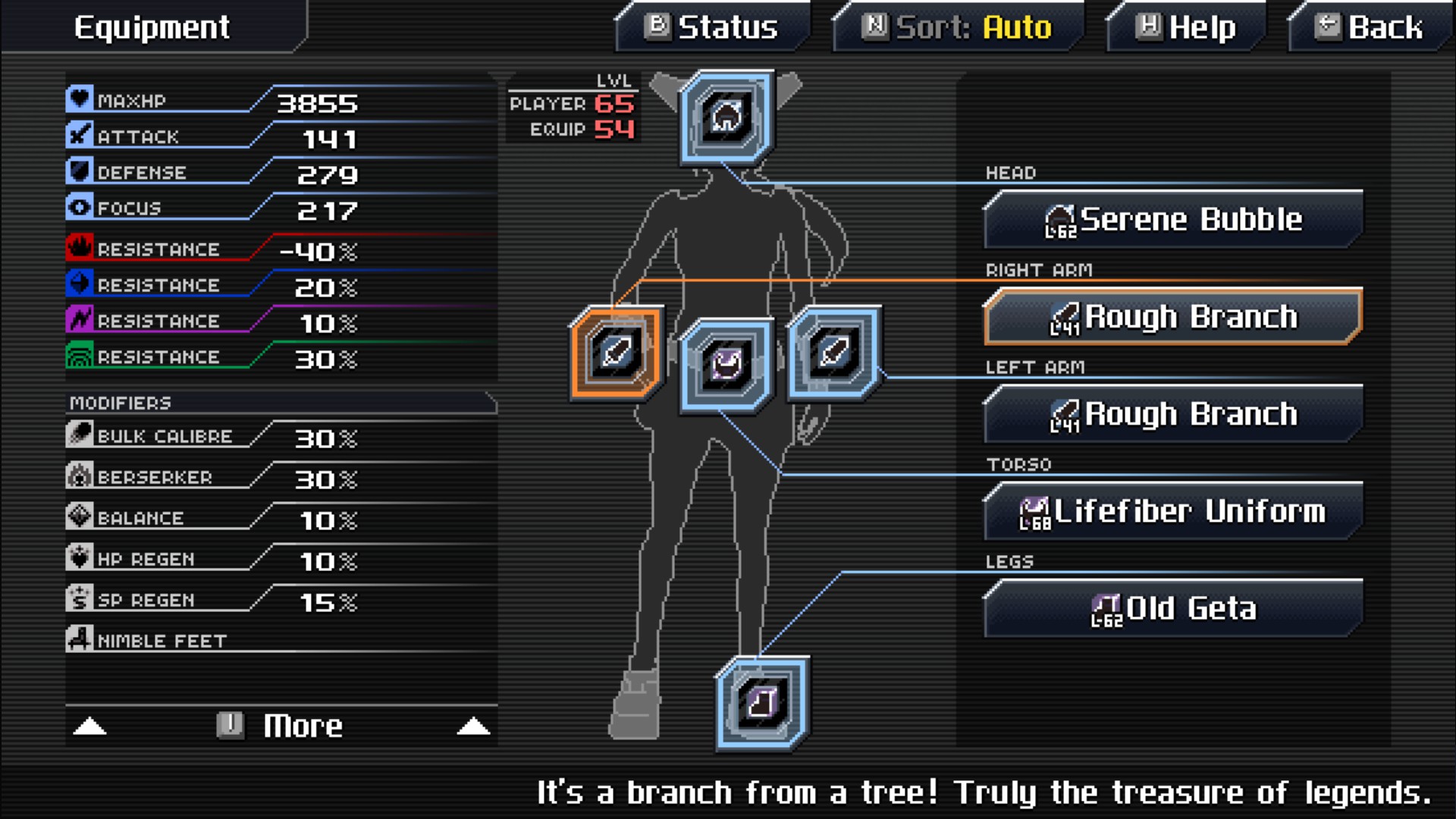
I can only wonder how much faster I could have beaten
 this game if I understood what most of this shit meant.

But its hard for me to complain that much because no matter how many times I put it down, it was a game I kept coming back to no matter what made me put it aside in the first place. Once I really started to understand how the puzzle mechanics work and story really got rolling, I found myself incredibly immersed in this one. I am looking froward to some DLC updates because I really do hope this story continues, because its the only dimmer on this overall solid experience, and even then it was a mild disappointment at best.

CrossCode came out to little fanfare, but its certainly starting to catch the right set of eyes. And now this once PC only experience is about to come to the Switch and the PS4, and that is only a good thing to help this game really get out there. More people should play this game. It's an incredibly solid experience that blends a lot of familiar game elements to make it feel truly unique. It's got a sense of humor about it that keeps it from taking itself too seriously, but also does a good job delivering it's emotional punches of the story. The puzzles are well thought out and clever, the combat is fun and challenging. Its only 20 bucks and is at least a 50-60 hour experience with updates on the way. I can't ask for an better entertainment dollar and give CrossCode a strong recommendation. 


Also, with a code, Lea will idle and do Caramelldansen.
Fucking. Sold. 

Friday, July 26, 2019

Celeste (PC): Conquering Your Mountain.

Contrary to what a lot of people may think, I don't actually play every video game that comes out. It's not for lack of trying, mind you. People are exhausting, I have to talk to them, engage with them, Leave my house to see them? Ugh. But despite my best efforts to dig myself into my private little hole with games, the fact is there are so many developers putting out content it's nearly impossible to keep up with all of it. 

So sometimes, a game that is critically acclaimed or very popular sometimes gets by me. Sometimes I never notice it, sometimes I never have time. Now this one I didn't know very much about but I did know its name and primary character. Every time I'd see a stream mention or play it the chat would go bonkers about it. It got to the point where I felt I missed out. So with me looking to rip through some steam games on my stream, and a fresh batch of summer sale games, I finally sat down with.....

CELESTE(PC)

We start off Celeste in control of a young woman with orangey red hair and a blue winter jacket named Madeline. She has left home to come to Mt. Celeste with an unexplainable urge to reach its summit. At the base of the mountain she crosses path with a polite but discouraging old woman who warns Madeline that she should not try to climb this mountain.

Ignoring her warning, Madeline begins her ascent of the mountain. After a brief starting climb, Madeline makes camp for the night to prepare for the next part of her climb. But as she sleeps, she dream where are dark reflection of herself breaks from her mirror reflection. This doppelganger, which she calls a "Part of Me" condescendingly tries to impede Madeline from climbing, at first with words but then by force. Madeline awakens visibly shaken but not deterred from her goal, and continues her ascent.


So when I first fired up Celeste I had an immediate ping of familiarity to the overall design and controls. One quick google search showed me that Celeste comes from Matt Makes Games studios, which is dev team that produced Towerfall: Ascension which is a game that I very much enjoy and has been a staple of my yearly Extra Life charity stream. So right out of the gate hopes were riding hire than if I had gone in cold.

Celeste at its core is a pixel based precision platformer that starts off with simple, tight controls that will gradually ramp up in difficulty as you learn new tricks, and progress further up the mountain. There are 7 total story chapters in total and one bonus epilogue chapter. 

Now when I say a term like "precision platformer" I usually think of games like Super Meat Boy and their controller snappingly frustrating difficulty. Thankfully Celeste doesn't start out that rough. The chapters are basically broken down into a hybrid of an over arching map that are connected by single screen challenged. Some of them fit onto a single screen, some of them will scroll as you move along.

Sometimes a level will just click and you fly through it, and those moments are immensely satisfying. 

Generally these are all connected on a single straight forward path but you aren't always locked out from backtracking if you need to go back for something. This is only necessary if you are a competitionist, as most of the time you really just need to progress further. In some later stages keys might be required to progress forward and those maps will have a more circular sprawling design, but this isn't a game where you typically get lost.

The core mechanics in Celeste are just a few abilities. You have a jump button, you have a dash button that you can use once in any direction, and you have a grab button that allows you to grab on walls and climb them. Your dash will recharge if you land on solid ground, or hit specific level context items (such as bounce springs or bubbles, for example). If a few short instances you can also use your wall grab to carry something.  But ultimately, those are all the controls in the game.

Whelp. That is unfortunate.

Each chapter is defined with their each unique level quirk that Madeline has to incorporate in order to each stage. For example, in the first run of stages you will come across various sized mechanical boxes that are connected via a chain loop. If you land on or grab the side of it it will cause the chain to active to move the box. These can be used to reach new areas, get into better jumping positions, or used as a launcher to get more height on your jump.  

In addition to these, there are hazards in every level be them pit falls, spikes, enemy npcs and so on. A person in one of my streams referred to the game as a resource management game, and that's a surprisingly apt comparison. The concept of the level design may be fairly obvious, but you need to manage to do it using the limited amount of dash and grab stamina you have to get to your next safe landing. The game has pretty clear indications of your limits, too. Madeline's hair changes color when she uses her dashes, and she blinks when her stamina is going to give out.

The design does a good job of teaching you how it works easily before throwing harder setups at you

Like stated earlier, the game's difficulty starts off pretty genteel but it ratchets up in a real hurry. Because of this, thankfully, there is no lives system and checkpoints tend to be pretty plentiful. Pretty much every screen transition is a checkpoint, and in some longer maps you have some sporadic mid level checkpoints. It loads quickly so dying is a momentary inconvenience. But you are going to die, and you are going to die a lot so get used to it.

Along the way in Celeste you will find collectibles as well. Primarily in the form of winged strawberries, cassette tapes, and crystal hearts. Thankfully, none of these are required to actually complete the game, but the game does keep track of them, and the ending card changes only sightly depending on how many of the strawberries you collect. These are what will test your mettle in Celeste, more so than just completing the level.

The cassette tapes and crystal hearts are more rare than the which are much more difficult to find or collect. But these serve a purpose in unlocking more game content. If you collect more of the cassette tapes you unlock the B-side levels, which are basically more challenging versions of the maps you've done. Manage to collect all the crystal hearts, and you unlock the C-side levels. So while the story may only be 4-8 hours long, you have a whole lot of game content to unlock as well.

As you can see, the B-side levels are really going to test your ability.

If you have played Towerfall: Ascension before then the graphics are going to seem real familiar. It uses incredibly low res, yet finely detailed miniature pixel sprites. It's actually very impressive. None of the actual character pixels have facial details, but all of their animations cycles are detailed enough to see exactly what limbs are moving, or what separates her from something she carries. 

The levels are designed with very vibrant and contrasting colors so with the exception of where some levels are moving at a quicker clip, it's very easy to distinguish what parts of the level are fore and background, and what elements of the stage you can interact with. Granted I am always a sucker for great sprite animation, but there was a lot of meticulous care here to make sure that the levels are all designed in complimenting palettes to keep within the theme of the level as well. The effects for dashing, stamina, wind, snow are all complimentary without them overpowering the general level design.

They also do a couple of nifty little visual tricks with the conversations in the game as well. Each character's text box is unique to them and when they enunciate certain points of effect the text in certain lines will shake, wave, bounce, and so on. The character faces in the boxes also switch due to emotion which really adds the character, almost to the point of 4th wall breaking at certain points which I exceptionally liked. It does a lot with a little to really build the characters where they can in this one, and I liked that a lot.

I struggled in this segment a bit because I couldn't get the timing of the dash down.
Never could time the bounce off his head correctly.

Celeste features an incredibly chill soundtrack from the mind of Lena Raine. You would think that the music would be designed to be more dramatic or uptempo, but theorize that wasn't for a couple of reasons. Primarily, I feel is soundtrack is designed in a way to produce a more calming effect. Because of the very nature of the gameplay, you are going to be met with some frustration. But by having this relaxing chill ambiance in the background, I never found myself getting as angry as I usually do with games like this. Sure I got mad and yelled a few times, but they were few and far between. I have a real hard time describing what genre of music this would fall under, but this would be great to try to sleep to. 

But the other reason, and probably the reason the game is so universally acclaimed is that it works to compliment the story. You'll note from my opening that the story introduction is somewhat bare bones. The reason for this is because much of the actual character development isn't handed to you at the onset, you get little nuggets as you play through the game and meet other characters. Specifically a fellow traveler named Theo. 

You come to learn that while Madeline is headstrong and courageous to the point of stubborn, But that she is also deeply, deeply troubled. She suffers from deep seeded depression and anxiety, and through conversations with characters also reveals that she suffers from regular panic attacks. She has poor coping mechanisms, she self medicates with alcohol, and basically lashes out online. She doesn't really have a reason for wanting to climb Mt. Celeste outside of doing so to spite herself.

via Gfycat

I can see from this why so many reviews empathized with Madeline. She is a great character and very relatable. Almost too relatable. Spoiler warning but in the later stages of the game you have a conversation with Theo where Madeline comes clean about a lot of the problems she sufferers from. A lot of them hit close to home for me, frighteningly close to home. Almost as if the game was directly provoking me about it. 

Celeste was definitely developed with a personal story to tell. These experiences feel real and personable, and for those who don't struggle with these issues it provides a decent window to what it's like to have these kind of vices. They humanize the characters, make them feel real as opposed to just being characters in a game. There is a truly exceptional sequence of the game where Madeline tries to face the "Part of Myself" which becomes a harrowing chase sequence of stages where the bright colors of the background are corrupted by the dark tones of her dark side, and you have to cut through them to make the recede. It's probably the emotionally strongest point of the game.

Easily probably my favorite part of the game not just for gameplay, but also for story and use of visuals.

And once you start to connect the dots? Everything in the game becomes an analogy for dealing with anxiety and depression. The challenge of climbing a mountain, getting stuck in a particularly difficult patch, falling back down and trying to climb back up, dealing with people who want to help but don't really understand. That is really where the cleverness of the story takes it hold, because almost every aspect of the game loops back to the central themes. It's smart writing.

But as you can tell from a few paragraphs ago I wasn't as moved by it as so many of it seem to be.  Perhaps because I have currently dealt with similar problems I didn't affect me as strongly. Perhaps because the description of the issues felt a little bit lip service, and didn't delve deep enough to really emphasis the crushing nature of these feelings. I would have loved if they found a visual shorthand to incorporate into the mechanics. Like if moments when she's having anxiety/depression, the gravity effects change in the level. I'm not a game developer though and admittedly, I am probably being somewhat unfair because of personal reasons compared to the layperson playing the game.

Low blow, game. 
Now, from a purely technical standpoint? Celeste as a game leaves me with virtually no complaints, and that is pretty rare as I've always said every game has faults. The controls are tight and intuitive, the music and visuals are consistent to the theming, the story is well constructed but not so dense that it doesn't disrupt the game pacing, and the levels and overall play time are just the right length so that it doesn't become so frustrating that I stop or become bored with the game.

The only real complaint that I have can't even really be marked against it because it's literally the nature of the gameplay. In some of the later stages of the game, the pathways to solve a level require near pixel perfect precision. There is a late stage level where you have to course of 6-9 frame perfect air dashes through very tight corridors of spikes that I was just 100% certain I was never going to get through. It was frustrating, but I can't hold it against the game because this is exactly what the game is designed to be.

via Gfycat

There is no doubt that Celeste deserves the praise that its earned from it's merits. It's easily one of the most technically sound games I've ever played. But I don't feel the experience was as emotionally powerful as many reviews made it out to be. Perhaps because of the sparring nature of the storytelling and limited number of characters and time with them effected my stance on that, because it didn't have the emotional punch like games like Undertale or Persona 4 do with me so I do feel like there's a bit of puffery here.

Celeste isn't a game that reinvented the wheel, but ultimately it didn't need to. It kept to its core mechanics and polished them to an absolute mirror finish to produce a fine precision platformer with great soundtrack, heartwarming characters, and sizeable playtime. For 20 bucks you get a great amount of entertainment for your dollar, and honestly despite finishing the story I expect to come back to this one to get more collectibles.  Celeste was a great game and is absolutely worthy of a high recommendation, I just wish I got to have the experience everyone else seemed to.


Seriously, Madi explaining how she deals read like
the developers have been spying on me. >:|

Saturday, February 16, 2019

GRIS (PC): Short but sweet

It's always a risky when a creator you know changes up things. Sometimes is great, and you get the jump from Evil Within to Evil Within 2. Sometimes it's not great, when you jump from The Black Album to Load. Creators are ultimately artists and it is certainly their prerogative to do things differently if they so chose. But in the realm of video games this can sometimes be a gamble.

So you can imagine my surprise when I started seeing screens and gifs from Devolver Digital for an upcoming artsy platformer. This is a company that produces silly and quirky games like BroForce and Enter the Gungeon. But a pretty looking indie platformer? That's not their normal wheelhouse. That being said I was hearing some very positive things about it, so with a free gap in my stream schedule to use, I took the plunge into.....


GRIS (PC)


As is with most indie games, there is no vocalized story. It's a journey you have to go on to interpret your own meanings. The game begins with young woman eponymously named Gris curled up in a cracked stone hand. She beings to sing but as she does, the hand beneath her beings to crack further and fall apart. Suddenly the girl loses her voice and cannot sing. She rushes to the edge to evade the cracking fingers, but the hand breaks apart and Gris falls down to a white and grey colorless void. From here, we take control.

This is going to be a tricky review for a number of reasons. Mainly because I don't want to provide any spoilers if you are looking to try this one for yourself, but also because there are not a lot of mechanics to this one, and there is a reasonably short playtime. This might actually be one of the shortest reviews I write come the end of this.

So when you assume control of the game all you can really do move left and right. When Gris (as I believe she is actually called) gets some speed to her step, you will be able to jump. Another button will show her lift her arms and tilt her head back, but it does not do anything.


As you walk through the stages you will come across roadblocks and gaps that you will need to find ways across. When you come across a gap you typically will be noted by a some chimes of sound and what appears to be a hollow constellation. As you continue, you will be herded to find what appears to be stars in the environment. These will connect on the gaps where you found the constellations, and will sometimes provide you a light bridge to cross, or a new ability to use, or fly up into the sky to a constellation that you will continue to build on as you play through the game.

There are only a small handful of mechanics to this game, but the game does use them in interesting way to create a slew of puzzles as you progress through the game. Some of them using more than one if not all of them, on top of some other mechanics that are introduced specifically for that section of the level. Some examples are some red butterflies that allow Gris to essentially launch into the sky, or a line that when you break through it flips and inverses the gravity. The game also uses some water mechanics as well.


For lack of a better explanation, the games elements are somewhat founded by the use of their colors. As Gris progresses through the game and you hit checkpoints, the game will explode with a splash of a specific color, and that will introduce a new environment mechanic. Such as when I hit blue, all of the water based mechanics and puzzles came into effect. Now that I am reflecting on it, the puzzle elements do have a symmetry to the color used for that specific portion and is very cleverly done so.

There is also a degree of inspirations to similar games of this type. There is a segment very early on that is basically a stylized variant of something that happens in PlayStation's indie game Journey, right down to it occurring in the colored level that would closest match Journey's setting. There are a couple of little nods like this, so I see them more as homages to inspirations rather than lifting an idea.

The visuals in Gris are simply stunning. The entirety of the game is drawn in a stylized hand painted water color. It has almost a comic line coloring to it, but as I streamed it was told it reminded one viewer of a movie called Fantastic Planet for its uses of silent and flowy animations. As I played through it, I couldn't help but feel a drawn comparison to the Cloud segment of the old anime Robot Carnival, another film drawn in that 70s animation style.


Its score is just absolutely gorgeous. Somber piano notes, strings, wind and occasionally some accompanying vocalization.  It blends with Gris' visual design seamlessly, and fits with the indie narrative that it is trying to tell. It's an incredibly chill and beautiful soundtrack, and kudos to the Berlinist for their work on it.

I could almost make the complaint that the its soundtrack is too chill. I had this same problem when I played Nier:Automata that when I was playing the early stages of the game, the slow pace of the progress combined with this chill (but beautiful) OST was quite literally putting me sleep. I'm trying to host an interesting stream and I am yawning and struggling to keep my eyes open. It is not a good look and not doing the game any favors.

The puzzles are well thought out and use a number of the mechanics in interesting ways. Although outside of a few of them, I wouldn't say that the game is very difficult. There were only a handful of moments where I got slightly hung up as I was trying to solve the game or gather a collectibles. The collectibles in the game are called "memories" and when you finish the game you can go back to previous levels to try to find the rest of them. If you do, you can unlock one more final scene to the story.


Doing this can add some length to the game because like I said earlier, it's not very long. I played the game on a stream and start to finish I had the main playthrough done in just about 3 hours or so. I am not sure if going back to find memories allows you to use the abilities you gained in the playthrough, but I feel at best this would only add maybe an hour or two of extra gameplay tops.

So this begs the question, is 16.99 worth three hours of entertainment to you? I managed to nab the game for 15.29 so I suppose I can say I got the same amount of experience that I would have if I spent that money at the movies. If that's the comparison I am using, that's probably fair because that means that Gris is not overstaying its welcome, and it wrapped up its story before its actual gameplay mechanics started to feel samey and derivative of its own experience.

On the other hand, I am also a gamer and it's hard for me to not feel short changed sometimes when I buy a new game and inside of a sitting or two I have done all that I can with it. Like I've said in other reviews, replayability is a big factor for me when it comes to buying a game, and it's hard to say that Gris really has any if I can do all the game has to offer in only 2 or 3 sittings.


With a game like this it's not easy for me to give a a proper recommendation because you sometimes have to look at these kinda indie games as the art pieces they are.  If you are the type of person who is okay parting with 20 bucks for 3 hours of an experience then I would absolutely say to try Gris. If on the other hand you are one who really needs a game to have some meat on it then you could probably get by watching a stream or let's play of it.

But that really is the best way to describe Gris at its whole: it is an experience.  A beautifully scored, very pretty experience. I'd think part of the fun of it is to play through and talk to others about what you think the game meant, and what you took from its visual cues. While I didn't have the same emotional connection I did in a game like Journey, I still enjoyed Gris very much. Whether you opt to buy or view it, it's absolutely worth your time.


The stick legs and arms were an odd choice, though. 

Wednesday, October 10, 2018

Death's Gambit (PS4): Facing Death

My friends. I have a confession to make to all of you: I am a fan of Dark Souls. I know, I know. I'll give you a minute to recover from this staggering bit of realization, but it's actually true. Before even! When From Software put out Demon's Souls they essentially created a game genre that was eventually perfected with their magnum opus: Dark Souls. Since then many companies made their own iterations to try to capture some of the magic. Some are bad, some are ok, some are compared even when they shouldn't be (look'n at you, Nioh). 

But it's the ones that try to take that gameplay style and mechanics system and blend it into their own creations that grab my attention. And when this one came out this past summer, there were certainly more than a few reviews of this one that I started to take notice. Made by White Rabbit studios and published by Adult Swim Games, I felt this would be a good investment for my recent PlayStation store gift card and sat down with....

DEATH'S GAMBIT:(PS4)

In Death's Gambit you play Soren, a knight in service to the nation of Vados. When Soren was born his father was drafted to a war known the "Great Expedition" per the fiefdom of their home. His father never returned, so Soren grew up under his mother, Evelyn, who tried to instill to him to live a life that is one worth remembering. As the campaign continued onward, eventually Soren's mother was also drafted and did not return.

To follow in his mother's footsteps, Soren also became a knight to join the Great Expedition as well and led a company into battle. The game begins shortly after this, where a Vil'dradur (A Dragon/Lizardesq race of people) warrior called Vrael is seen dragging Soren's body to a burning pile of Soren's company. Nobody else survived. Taking a jaded pity on Soren, he tells him to return to Vados. The battle was lost and there is nothing left for him here.

But just as he goes to leave the battlefield, Soren is confronted by Death himself. Death has granted Soren immortality, but only if he accepts a contract into Death's service, asking for a single favor. With nowhere to return to and without any cause other than to try to find his mother, Soren accepts the contract and continues forward.


As I eluded to in the introduction paragraph, Death's Gambit is a 2D metroidvania style Souls clone similar to the vein of my previously reviewed Salt and Sanctuary. Many of the mechanics that you would recognize from these games are going to be in play here as well as a number of unique mechanics as well.

While using the Souls comparison for the game mechanics, I would say its actual play style feels closer to Castlevania. It has a pretty arcade speed to it as the character moves reasonably fast and the jump is quick, although a little loose. It uses the face button scheme instead of the more traditional souls trigger system, which makes more sense given the 2D plane that you play the game on.

Combat is generally what you would expect. You are able to equip two different weapons (usually a melee and ranged) that will deplete your stamina as you fight, forcing you to back up and replenish before you can resume. You have a dodge roll move that like its Soulsian heritage also depletes stamina but gives you invincibility frames for a significant portion of the roll. This is a essentially the core, and about where the comparisons to Dark Souls ends.


You also have a "Soul Energy" gauge and this is bit of a clever mechanic because when designing your character, your character class actually directs how you actually fill this gauge. For example, I use a rogue in this game, and they fill the soul energy by attacking relentlessly and with aggression. But if you were to say play as the defensive minded sentinel, this gauge increases by defending or parrying attacks.

This gauge is how you perform up to 3 different special attacks, in lieu of a magic system. On top of having to fight to build energy for these attacks, your soul energy also degrades over time so you may not always have an attack ready to go at the start of a fight. These abilities also have cool downs that naturally force you wait between uses. In conjunction between the stamina, energy, and cool down it produces this interesting balance that both rewards aggression and pace, while preventing spamming abilities and forcing awareness of your limits and defense.


A good deal of the of the equipment that you use of the game pretty boldfacedly tells you that many of the weapons are stat specific, so right at the onset when you build your initial character you will have general idea of where you want allocate your built stats.

This too, follows the standard RPG/Souls stat system. I'd probably akin it more to Bloodborne as it's relatively simplified to Vitality, Strength, Endurance, Finesse, Intelligence, and Haste. You could balance your build if you like, but more than likely you will find yourself splitting between your main attack attribute and more life and endurance.

Much like its inspiration, your starting character is just a jump off point for you to customize.

Also, much like its inspiration, it bills itself as an open world game for you to freely explore and tackle in any order. It starts off on a somewhat linear starting point and once you reach the main sanctuary (eg: firelink shrine) you are then free to branch out in multiple directions and see what path works for you.

The experience system, however, has a few subtle differences that I really liked. As you know with most of the games aping this system as you gain experience, souls, blood echos, diamyo, etc you then use that level your character, purchase items, learn new abilities, and upgrade your equipment, when you collect it and you die, you drop it and have to go back for it. If you die again, it's lost. Right?


That is not Death's Gambit does things. It's equally more forgiving and punishing. Because now when you die, you don't actually lose your experience. So you will never find yourself caught under-leveled and panicking to find the next death statue you spend those points. Instead, you drop your phoenix feathers. These are your primary rechargeable healing item and they are in a limited supply. Say you have 5 feathers and you die in the boss encounter, you then warp back to your last save and have to go back with 4 feathers. If you die again before getting back to the boss, you drop another. Now you have 2 less and still need to get back to where you dropped them. It's a unique punishment to carelessness.

These feathers also have a interesting strength buffing mechanic. When at checkpoints you can choose to limit your supply of them for 10% damage increase. I think the max number of feathers you find is 10, so when I play in NG+ modes I find myself allocating 6 of them to give me 60% attack boost to really layer the damage on enemies and bosses. If 4 feathers isn't enough for me to fight then I am playing much to carelessly. These feathers are not lost for good because you are able to spend experience to reclaim them (including ones yo, but it does cost more to do every level higher you get.

I will say boss fights have an interesting reward mechanic that will keep you engaged. If you happen to lose in a boss fight, it takes you to a screen where it shows you the boss and their life bar. That life bar will deplete to the amount of damage you did. As it decreases it awards you the experience you would have earned by taking out that much health. When you try again, you won't be awarded more experience unless you do better than when you last attempted the fight. This provides a nice little psychological push to make you give the boss another try.


This game as an incredibly chill, piano based symphonic soundtrack to it. It never really dips itself out of the classic territories, and makes for very good ambiance music. I wouldn't really consider the soundtrack to be iconic in any capacity, but it does have a very somber opening theme that I enjoy, and all of the music seems fitting for the scenes. A lot of Souls comparisons could be drawn here as well.

But the best aspect of the sound design is how competently voice acted this game was.  Matt Mercer plays Death and he has pretty much become a staple in the video game voice acting world so naturally he just nailed his part. But a lot of the voice actors according to the IMDB pulled multiple roles, basically reducing all the roles of the game to about 10 or so voice actors. It was very impressively done, I didn't find any of the lines to be particularly cheesy and hokey. Once I actually started to progress in the game, the voice did a lot to help me get lost in the story.

Although I do have to knock that, for some reason, Soren is a silent protagonist despite having lines of dialogue that don't change from play through to play through. What is the purpose of this? I complained about it in Tales of Xillia 2 and it makes just about as much sense here. You gave him lines of dialogue, you armed your game with very established and competent voice actors, many of them already doing multiple roles. You couldn't have one of them read Soren's lines? Fuck, have Matt Mercer just use his Troy Baker voice to continue further to confuse me, and that would have worked just as well. I do not understand this decision.


Graphically, it's another game that draws inspiration from graphics of old so it's another one that resorts to pixel animation as opposed to rendering. That being said the games monster design is fairly well detailed with lots of different frames of animation. Some of them fair better than others, I will admit. There is one particular boss fight, The Tundra Lord Kaern, that has a failing attack that looks like it could have used a few more animation frames to look a bit more fluid.

That actually kinda leads to one of my biggest issues in the game. Salt and Sanctuary managed to completely nail the timing that made their game feel like a 2d souls game would feel. Its timing, fluidity, weight of actions all felt... right. Death's Gambit gives me kind of a loose, arcadey feel to it. Specifically when it comes to jumping. The jump is very fast and immediately halts the moment when you let up off the button, which makes the jump feel very bouncy and forced me to pay more attention to my jumps because now the timing is significantly more important.


Combat as a whole took some getting use to because depending on the weapon you chose it affects how you move in the battle when you swing. I first started the game as a Scythe user and I couldn't get the knack of it because the animations would move me so much farther forward than I was expecting to go and multiple times I'd helplessly fall into traps or miss my target because I was moving too much in combat. I eventually restarted and switched to daggers.

But even then, I found some of these controls to be somewhat unnatural. Perhaps that is not the correct word but some of these actions do not roll fluidly for me. For example, you have a kick move that you are supposed to use on enemies who are in a guard position, to do this you need to hold the button that draws up your shield, then hit a shoulder button that allows you to throw the kick. I never, ever get this right on the first time. I typically will take a hit or two trying to do this, and if I have more than one enemy after chances are I am going to take way more damage than I want to.


This game also has an incredibly frustrating barrier to entry. From a relatively stable easing into the game, one of the first bosses you come across is the Bulwark. Now, I've heard this guy can be beaten at level 20 (and there is already a level 1 speed run) but mother fucker this guy put a massive roadblock up in my game. Tack this on a period of still figuring out the controls and it's going to lead to a significant number of deaths in a row.  I'll be honest I was getting ready to put it down after a while

They say that the game is non-linear, but it really feels like it's not. There is a pattern I've found where the curve is definitely more forgiving and that you really should do because it unlocks all the necessary NPCs required to learn the skills in the game. I usually end up dealing with the Bulwark next to last. By finding this path it ended up giving a more fair leveling path and now I have pretty much have it down to memory.

The amount of equipment is tragically minimal. Most of the gear in the game only has one or two variants, and some weapons like the daggers there is no 2nd version at all. So you don't really need to worry about leveling up the wrong equipment because honestly there isn't much to level, just wear what matches your leveled stats. So it doesn't leave very much in the way of customization and that is pretty disappointing. This is also hampered in addition to the game's skill tree because there is no option to respec (even in new game plus), so it's entirely possible that you can miss big sections or treasures because you didn't commit to a specific skillset that allowed you to get there.


I was sort of prepared to go after the game for its story because it felt like your standard fantasy speechifying where they sling a bunch of names and fantasy terms together, and it felt like I wasn't retaining much of it because it doesn't sound like it means anything. But there was one area of the game that took a very strange tonal shift that caught me completely off guard, and by that point I was starting to find my groove in the game that was progressing a bit more smoothly. There is a lot of lore in this game, but again, like Dark Souls you have to go out and find it.

And this game feels like it is hiding a lot of secrets that I haven't unearthed. It has to be, there are too many mechanics that haven't been explained that have to mean something: You can cancel your contract with death, so when you die it deletes you game. You have to make story decisions on some characters at one point. NPCs can be killed (or murdered by other NPCs) and you can stop that, There is a NG+ option where you can raise the level from 1-10. There is an unexplained "fear" mechanic that has to do something.  So I hesitate to rip this story apart because they did actually put in a pretty significant amount of voiced over lore. There has to be more to this than what I am seeing.

Not every boss is beaten by fighting. Sometimes the goal is just to survive.

But worst of all, most unforgivably of all is this game crashes. Constantly. This game crashes with out any rhyme or reason to it. This game crashes when transitioning from one map to another, this game crashes when there are too many enemy projectiles on the screen, this game crashes when I am jumping to much and the animation doesn't catch up fast enough, this game crashes in the middle of dramatic boss fights in prompt of nothing that I can immediately see, this game FUCKING CRASHES WHEN YOU ARE SAVING YOUR GAME CAUSING ME TO LOSE ALL MY FUCKING PROGRESS WITH A CORRUPT SAVE.

This game has been patched more than once already, so the amount of crashes I have had with Death's Gambit is fucking unbelievable and ridiculous. No game close to release, and especially months after release should be crashing as much as this game has. So either the patches you are putting in is not fixing the problems, or you haven't even bothered to address them yet. Either way, it is a completely massive fucking black eye on this game because now I can't enjoy it to its fullest because I am constantly in fear of having this game just randomly close on me for no reason, and possibly lose all my work.


Look. The bottom line here is that I like Death's Gambit. It takes some pretty established mechanics and does a good job of implementing it and tweaking it for their own system. The sprite work is well done and the sound design is pleasing. It has fun boss fights when I get the controls down, and I'm working through a third play through of the game as I write this.

But son of a bitch it doesn't feel like it's ready yet. There is just no excuse of a multi-platform game to have this many problems months after its release. I hate day one patches but I would take 30 of them if it got this game to run properly. So I am torn how I want to deliver this. I want to give Death's Gambit a recommendation because ultimately I got a great deal of play out of it once the game started to click for me. But frankly, it might be worth waiting a few more months so they can hopefully address some of this shit.

If you lost your progress because you left Death's contract, that's on you. If you lost your progress because Death's Gambit crashed on you, that's on the devs. Purchase at own risk.


I'm going to be pissed if I finish NG+10
and there is no secret ending. 

Thursday, October 4, 2018

A Hat In Time (Steam): A surprise hat thrown in the ring.

Sometimes there are games that you hear about and just from the couple of sources you trust you know that you are going to want to try it. That was kind of where is was at with this one. I heard the game mentioned a couple of times and I heard some pretty positive reviews about it without reading too much into it.

So naturally when the steam summer comes around I have games like this one locked, loaded, and ready for purchase. It dropped a bit so I jumped on this one. It sat in the backlog for a bit, but while looking for something new to play on my Thursday stream and this seemed like a good change of pace. So with that, we donned our best cap and dove into.....

A HAT IN TIME:(STEAM)


So contrary to what I had assumed, this is not about time traveling girl in a dashing top hat. That's only part of it. Hat Girl, as she is known, is an alien simply flying home in her spaceship. But as she passes over a specific world, a member of their local mafia bangs on her front screen demanding a toll. Hat Girl refuses and the Mafia smashes her window, causing her vault to fly open and suck out these glowing hour glass "time pieces" as well as herself out into space to the planet below.

There, Hat girl meets a local trouble maker in a red hood and a dashing mustache, hilariously called Mustache Girl. Initially, after Hat Girl helps her get free from the Mafia, Mustache Girl agrees to help find the missing time pieces if Hat Girl helps her run the Mafia out of town. Things go well until Mustache girl learns the time pieces can be used to actually alter time, and has the idea to use these to be time traveling heroes and ride the world, and other worlds of their bad guys.

Unfortunately, Hat Girl needs to them to power her ship and get home so she declines. Mustache girl claims this is a selfish use of them, and after stealing from Hat girl and dissolving their friendship, it then becomes a race to see who can collect the time pieces first.


Spoiled a little of the story there to give context, but that is more or less the framework of the story and its as good a motivation as I needed.  As I eluded to in the intro to this one, I basically went into the game pretty much not knowing a thing about. But now that I have played through the game from start to finish, there is only one way I can describe it:  A Hat in Time is a love letter to the 3D Super Mario platfomer. So expect a good number of comparisons to it.

At the onset of the game, Hat Girl has pretty limited bag of tricks. She can run around, and jump, and has a umbrella that she can swing at enemies. When she is airborne and someone comes into range, you can hit the attack button to do kind of a homing flying dive at a baddie. Its a generally invulnerable move but its not fluid or fast. So you will more than likely bash things with your umbrella until you are prompted to use the aerial attack, usually by bosses or specific enemy types.


You have 3 primary objectives every time you drop into a new level. You need to A: collect pons which are gems that will let you unlock new buttons for you hats which give you new passive abilities. B: collect balls of yarn which allow you to unlock new hats, which give you new active abilities like dash, bombs, etc. and C: collect that level's time piece, which allow you to progress to the next chapter of the game. 40 time pieces in total.

As I sort of mentioned before, it draws a great deal from the formula that made Super Mario 64 work so well. Each chapter of the game is broken up into 4 to 8 acts which drop you into that world to go after a new time piece. And like much like its inspiration, each change of act might produce some subtle changes to the level on top of your ultimate goal.  For example, in the first world of Mafia town, the entire place is somewhat of a tropical beach island city.

Man, the Mafia are friggen jerks.

But in one of the acts, Mustache Girl turns on all these giant faucets that basically make them spout out lava instead of water, so now any of the water you could previously swim in now causes damage and require more precise platforming. The goal to unlock the time piece is to navigate around the new terrain to reach said faucets and turn them off. Worlds are generally open so you can explore around and see what changes and learn where you can go now or what ability you might need to come back later.

After completing a certain number of acts (you don't need every time piece) you can move to the finale of the act which usually results with a fun, interesting boss fight and the closing of the story for that set of worlds. All of them individual to each other so while it does lead to a big final story arc, each chapter feels contained and different so they feel different, fresh, and unique.

You can always replay levels to go back to reload on pons or try to get more yarn to get new hats for more abilities. It is entirely possible to beat the game without having all of them because I was able to do so and do so without much difficulty. As you play, you can also find time shifts. Again, much like in the 3D Mario games and would say Mario Sunshine in particular, time shifts are these kinda surreal floating in space pocket levels that usually involves some trickier platforming to complete in basically a wide infinite undersea/spacescape. Most chapters have 2 or 3 of these.


So I'm not gonna lie, There is a lot to love about this game. First off this game bills itself as "A Cute as HECK platformer" and I'm hard pressed to disagree. Everything about the art style gives me a nostalgic Saturday morning cartoon feeling about it. Cartoony style caricature with big eyes and character proportions. A lot of absurdist scenery. Each world has its own differing theme with characters to go with it be it a train car of birds, a forest of ghosts, or a mountain of shamanic goat people. In the recent DLC update, they also added a "retro" mode to make the graphics looks like they are on the N64, and somehow that feels like it fits just as well.

Hat girl, who never actually has a full speaking line I think, has a lot of little character building animations that will happen when she idles or during the course of the story or level. She is a bit of a fun loving prankster and when approaching enemies she stick her tongue out and make a "bleeeeeeeaahh" sound at them. She'll make faces at people and tease. But she is also a sweetheart and if she befriends someone she'll blow kisses that have little hearts. This game is adorable.

In more than one level, she'll have to sneak around silently. During these levels of the game you will notice that if you aren't using your dash, you will see that she is walking around holding up her hand in a finger gun pose like she's playing that she's a spy. It's a lot of these little animations that end up giving Hat Girl so much character to her personality without having to deliver a single line of dialog.


There are some pretty great supporting characters too. My hands down favorite is the antagonist from the 3rd or 4th act, a ghost called the Snatcher. He basically traps you at the start of the level and yanks your soul out, and then forces you into a contract to be his fixer. Everything about this character makes me laugh. His voice, the 4th wall breaking cynicism of his boss fight, he even has brief Undertale reference if you are looking for it.

One character I was expecting more from is the shopkeeper you use to buy new button abilities for your hats. He is a ghostly, spectral character with a floating mask and broken speech. Just from his overall design I expected there to be more story, or content relating to him. He ended up just being a shopkeeper like he said he was, which actually kind of impressed me because that is an awful lot of attention to detail for a character that essentially has no bearing on the story.

Every part of the game with the Snatcher is my favorite part. I love this character.


They throw in a lot of little game mechanics in this one to change the feel of it too. I mentioned the stealth levels that borrow mechanics you might see in a Metal Gear game. In one level you are just racing forward as the stage falls apart around you, using your gear to navigate the jumps properly to keep moving forward, like you might see in Uncharted, Tomb Raider, or even Crash Bandicoot really. At one stage a character wanted me to doctor up my picture for a movie, and so I am basically doing an MS Paint job over my picture as part of an actual story mission. It's hilarious.

Hat In Time also does some camera tricks like Nier: Automata did change the feel of a segment. The game for the most part is generally 3D in all its segments, but one boss encounter with the Mafia Boss, the game sticks a 2D plane for the entirety of the encounter. It limits the range of movement which requires you to have more precise jumping and timing of your aerial attacks to complete. Some of these changes also completely change the tone and feel of the game from level to level.


The game has some very funny writing. It's incredibly cheeky and plays with a lot of the tropes you expect in video games. A lot of segments are very sarcastically written. And while I have called this game a love letter to 3D Mario titles, there is a lot of love to go around as there are references upon references in this game, such as the C.A.W. agents from the Murder Mystery level, which are clearly drawing inspiration from the G-Men from Psychonauts.  There is even a text adventure on the ship that you can play that has some rather hilarious outcomes if you continue to play it. It even turns a trope I generally hate on its head and made it feel hilarious and new, while also providing me a much more difficult moral choice than I was expecting.

Right down to how they deliever their lines, the agents of C.A.W
are a direct parody of the agents in Psychonauts.

This soundtrack completely nails it. This is an OST that sort of does a lot with a little, and ends up giving us a ton. Each stage has their own unique theme, so naturally they all have a complimenting song that go along with them. But as you complete each of the acts in each stage, The song remixes to adjust to the changes of level, thus giving it the song a different feel while still being the same theme for said level.

But then, the game blindsided me with the exceptional rock-as-fuck boss fight themes. I first noticed it with the fight with the Snatcher and its highly covered theme "Your contract has expired". So it caused to me to go back and listen to some of the other encounter themes and almost every one of them is fantastic. I am really loving Contract and "The Battle of Award 42". Pascal Michael Stiefel absolutely knocked it out of the park with this OST. Some of you might be hearing some of these songs in my upcoming Extra Life highlight reel.


The game has a decent length to it as well and what I like about it is that it does not require 100% competition to get through.  It tells you right at the onset that there are 40 time pieces to gather, but you don't actually need all 40 to play through all the main chapters of the game. You DO need most of the hats to navigate through all the levels, but you don't need all of them. This allows for some additional replay value after you have completed the main story. If you wish to do the DLC chapter, it does require a bit more completion than required to finish the game, but I consider that post game content and don't hold it against it.

In addition to all of this, for the first day of its release they gave away the first DLC chapter away for free. While I can never be rid of the bane that is DLC, I appreciate gestures like this. The devs also released an update that provides modding support for fans to customize the game, and a multi player split screen mode that looks to provide some fun cooperative play/teammate trolling as you can hit the other player. I personally haven't had the chance to try the multiplayer, but for collector missions or finding time riffs, this seems like it could be useful.

Awwwww.. These girls...

There are some minor complaints at best. There is a looseness to the controls that 90 percent of the time feels generally feels pretty great when you are playing, but it becomes a massive annoyance when trying to time a jump right at the edge of a ledge. More than once I would be trying to time my jump and go over the edge because I wasn't hitting it as soon as I felt I needed to.

There is an air dash kinda move that you use to extend the length of your jump, which I hate. Not that mechanic doesn't work, but it also functions as your slide move when going down a hill. Again, also fine. The problem comes in is because this animation doesn't cancel itself, or with any of the main actions such as jumping again or swinging your umbrella. So in the occasional tight situation I would be trying to navigate tight platforms, land my extended jump, then die because I was scrambling to swing my umbrella or jump out of the way. It's annoying and seems like an easily fixable issue, and may be with upcoming patches.


As with most 3D games of this nature, there is some camera fuckery that can be a mild aggravation.  When having to do some wall jumping, climbing, or worse yet when you have to land on narrow platforms, you also need to sort of guide your camera while you jump to make sure you stick the landing. It's not exactly fluid and not comfortable to do, so chances are you will be making more than one attempt to hit a jump. This is incredibly frustrating when trying to jump on a clothesline because of the narrow target to hit. The level "The Big Parade" was probably the most frustrating example of this.

This is more of a personal complaint, but I would have liked health to be a little more forgiving. I wouldn't say this game is exceptionally hard, but hearts aren't as common as pons are. Unlike 3D Mario games where you get 8 health and coins restore it, Hat In Time only gives you 4 and only specific heart pickups restore your health. This makes the latter stages, and specifically the DLC update on a WAY higher difficulty curve than the rest of the game, which can lead to some frustration.


But ultimately, these are minor complaints on an all around solidly built game. The fact that this was done by an incredibly small team and basically shared in bits in pieces instead of working together at one office makes it even more impressive to me. A Hat in Time hits all the right points for me for a new property: fun characters, good soundtrack, great replayability, adorable art direction, the right amount of skill to be challenging without being frustrating, and so on.

Sometimes when there is a buzz around a title and you take a cursory glance at it you know that it's going to be right for you, and that is exactly where I put A Hat in Time. This game is appropriate for everyone and has a little something to offer everyone's gaming tastes a bit. I very much enjoyed this game and give it a wholehearted recommendation to anyone who is looking at it.  I just wish that I started it sooner.


Sorry Mustache Girl. But every British sounding
woman just sounds like Tracer to me now.