Showing posts with label Comedy. Show all posts

Wednesday, October 2, 2019

CrossCode (PC): The MMO I always wanted.

Despite what people a number of people feel about them as a gaming news site, I read a fair bit of Kotaku in my day to day life. Mainly because of a few select writers who I enjoy the work of and have some pretty similar interests as far as games go. One of those writers is Mike Fahey, and in his write up at the end of last year he listed his top ten games of 2018.

One of them, I had never heard of before. Wasn't even remotely on my radar. Had nice looking pixel graphics, and boasted itself as an MMO that's really not. Strange, I thought, but ultimately clicked away. But then I started to see the title popping up in some other sites top 10 lists. Now that had my attention. How can a game that appears on so many people's best of lists get by me? Well, that merited a deeper look.

CROSSCODE (STEAM)

Image result for Crosscode

CrossCode opens with us in control of a dark haired woman racing through a dark foresty area. She is on the hunt for her brother, and shadowy voice implores her to stop. She vehemently denies, saying that she is trying to stop her brother from working to death. The voice spawns monsters to stop her which the girl quickly dispatches. After tearing through the enemies put before her, she does find her brother just to see him collapse from exhaustion.

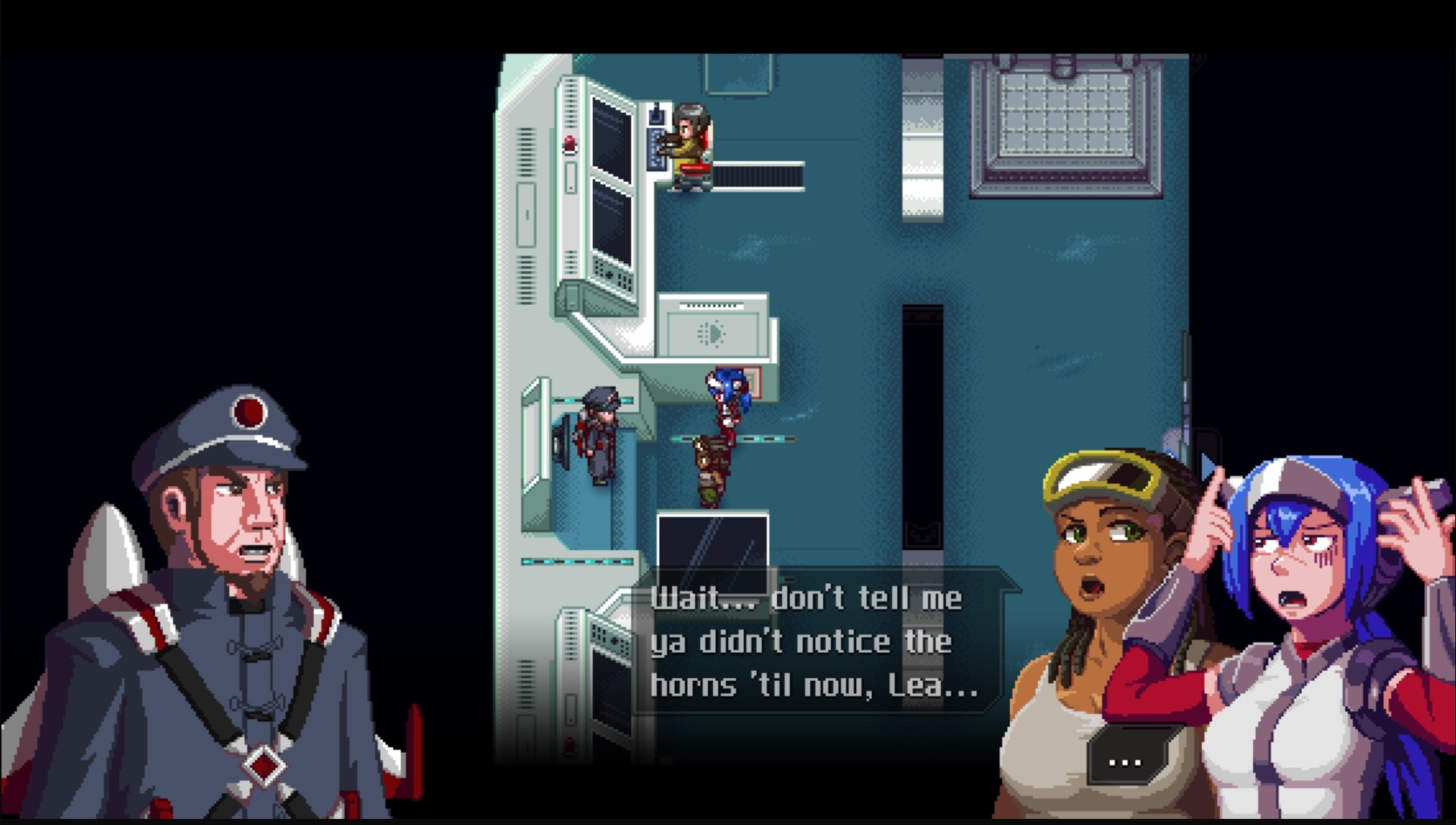
We are woken up in a different location. Our hair and outfit are slightly different. An operator tells us that our name is Lea, and we are actually logged into an avatar of the futuristic MMO called CrossWorlds. In the vein of Sword Art Online, Crossworlds is a game where the players are actually implanted in the game to a heavy degree of the 5 senses. Unfortunately, we are told there has been an accident and that we are in a coma in the real world, and we are being placed into the game to try to find out what happened.

To make matters worse though, our speech unit is damaged. We can understand fine, and give minor visual responses but we are told that in order to solve this issue and hopefully find some answers, we need to play the game just as if we were any other player in the game. Lea remembers the basics of how to use her Spheromancer class in the game and after running into a friendly Pentafist named Emilie in the rookie island, she and her new friend jump into the game of Crossworlds to hopefully learn what's happened to her.

Loaded for bear

CrossCode is going to be an interesting game to try to review because the mechanics of this game borrow from so many different various elements that it doesn't really fall into just one genre of game. For example like I explained that the Lea is logged into an MMO, but you would incorrect to assume that's what this game actually is. The MMO aspect of the game is used as a framework for the story and the world.

What I mean be that is, yeah there is some questing that is done in the style of an MMO. You need to go talk to NPCs who give you quests to do, and you'll go into the world and fight mobs to collect items or kill a certain amount of enemies. As you wander around the world you'll see other players just running around, fighting their own things, or just hanging out. All of these are computer controlled. This is a fully single player experience, but it does a very good job of presenting the illusion that this is a living world with other players doing their own thing. 

When I describe the game, I describe along the lines of a 16-bit Zelda game such as A Link to the Past.  It's stylized in a way that it would look at home on the Super Nintendo with a top down view of the world, primarily a 2d play, but there is some degree of verticality to the maps which allows for some platforming and parkour when wandering around the world.

The combat is going to be the real meat and potatoes of this game. It's core is a hack and slasher with bit of Souls to it. You can run around and slash with a couple of swings with a single button press, you have a block that pulls up a shield and can parry if timed correctly, and you have a dodge move that has some invulnerability frames that lets Lea gracefully spin from harms way, which she can do up to the three times. 

But it she wouldn't be a Spheromancer without some spheres, and that's where her ranged attacks come in. When using the right analog (or I assume mouse on PC) the combat becomes almost a twin stick shooter. Holding a direction will bring a pair of lines for Lea's aim together, and once lined up you can unload a continue stream of projectiles at an enemy, which is handy for fast or flying foes. You can also charge up your first shot to ricochet off walls or break enemy guards.

As you play through the game and unlock your circuit board, you open your skill tree which allows you to learn multiple techniques for special moves for your Melee, Ranged, Dash and Shield. What is nice about this is as when you commit to an ability path, once you fill out the 3 spaces for it you can actually flip between your options so if you don't care for how one ability plays you can try the other option to see what works for you better. Even further in the game you start unlocking elemental grids which provide you with even more options to fight with, so you do have a bit of freedom to design your character.

Having familiarity with your Techs will let you set up the right attacks for them

Now while I've gone into the specifics of the combat and referred to it as the meat and potatoes of the game, it would actually be pretty foolish to assume the game is just battling. That's what I did and I was promptly set up for some gameplay whiplash. As you play through the "story" for Crossworlds you come onto these "instanced" dungeons where you have to go without your party. And while these do contain a significant number of fights usually capped off with a spectacular boss fight, you learn that CrossCode is in fact a serious puzzle game as well.

Actually, when thinking about it, this game might actually be more of a platform puzzler than it is an action adventure because depending on the size of your giant space brain, the puzzles can be a major stumbling block. I am more than man enough to admit that there were a number of that I had to look up a solution for because I just was not seeing it on my own.
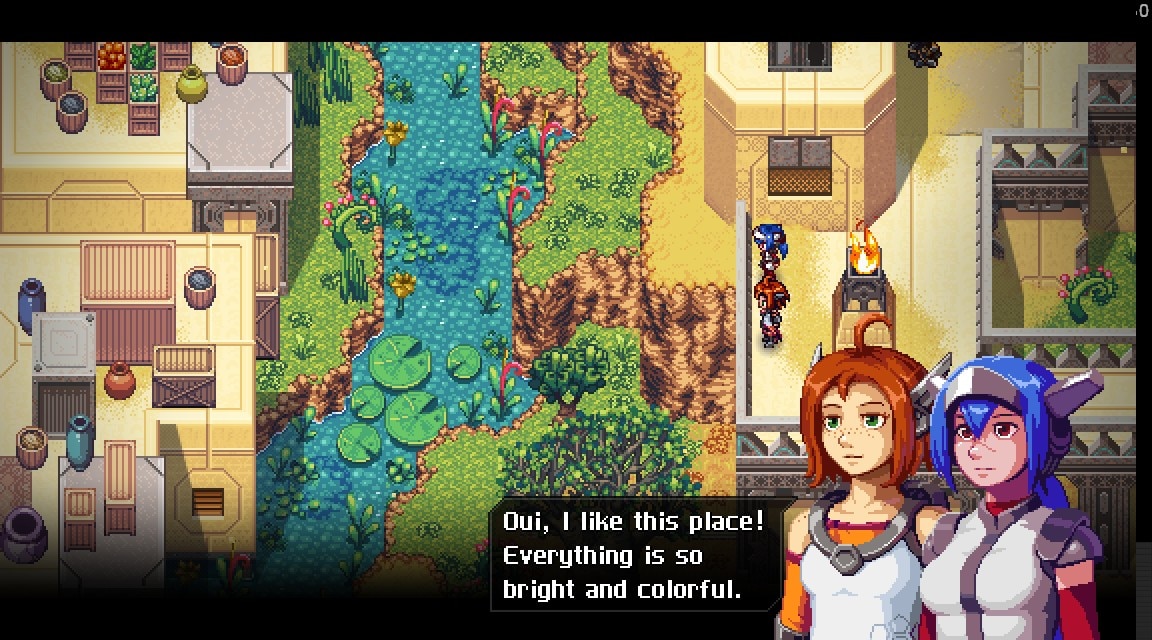
I love Emilie. She is just the right level of earnestness and naivety to make her impossible to hate.
Might be one of my favorite iterations of the best friend character. 

Sometimes the puzzles are just a matter of following the right path, and parkouring off the right environment pieces to get you from A to B. Sometimes the solution will require you moving around bits of your environment so that you can fire a projectile in the proper path to hit all the necessary points before coming on a final switch. Sometimes you will have to use the temples element for an environmental variant to the puzzles.

All I can say is some these will TEST you. Which can be frustrating because the story frames solving these dungeons like races against your friends. Like I said, I got stuck a lot. It wasn't until a friendly fan of the game in my Twitch chat told me to use visual cues on the floors of the puzzles to get a better idea of how to solve some these. It really did help a bit, but sometimes you can forget early mechanics that if you didn't use, would make the puzzle unsolvable, like remembering you can hop on fences.

So close, yet so far away

Outside from the puzzles, the actual combat can be very challenging as well. A lot of the enemies that you come across have their own unique weaknesses and patterns, so very rarely is just running and slashing away going to be the best way to dispatch something. It can work, but not always well. Then you have to bear in mind unless you use limited items to recover health, it doesn't restore until you finish fighting your combo chain. The more you beat enemies, the more valuable drops they give you, so its beneficial to beat a long string of baddies, but you have to be careful to mind your health.

To the CrossCode's credit, the options provide a very significant amount of customization to the overall game. Right from the onset, you are warned by the developers that this game meant to be a challenge, but if it's proving so difficult that you are not having any fun, you have options to bring down the battle and puzzle difficulties. It's a nice gesture and it gives the "git gud" scrubs less of an opportunity to be so insufferably smug when someone is struggling.

In addition to learning attack patterns and elements, you have to be mindful of ledges too.

CrossCode was a very weird game for me, because it was a game that I kept putting down. It's not because of a lack of interest of will, it is just a game that constantly got caught up in a retail release schedule as I played my games through the year. But there is something so inherently charming about it's whole presentation that always kept it in my mind. When I was playing something major like Red Dead Redemption 2, I always kept thinking "Soon as I finish this, I can get back to CrossCode".

It's story is interesting because it deals with a lot of fronts. First we have Lea's primary story, which is about her trying to figure out what happened to her. This is expounded to her by a character who is developer to the game, basically speaking to her directly. Then we have the Crossworld's "story mode" which is what we learn as Lea plays through the game with the friends she meets, and her interactions with those characters. Then we also have the front of what Crossworld's actually is, which we had a glimpse of at the start of the game and is told in flashback sequences. There is a lot to take in, but it does eventually tie together, (mostly. I'll get into that).

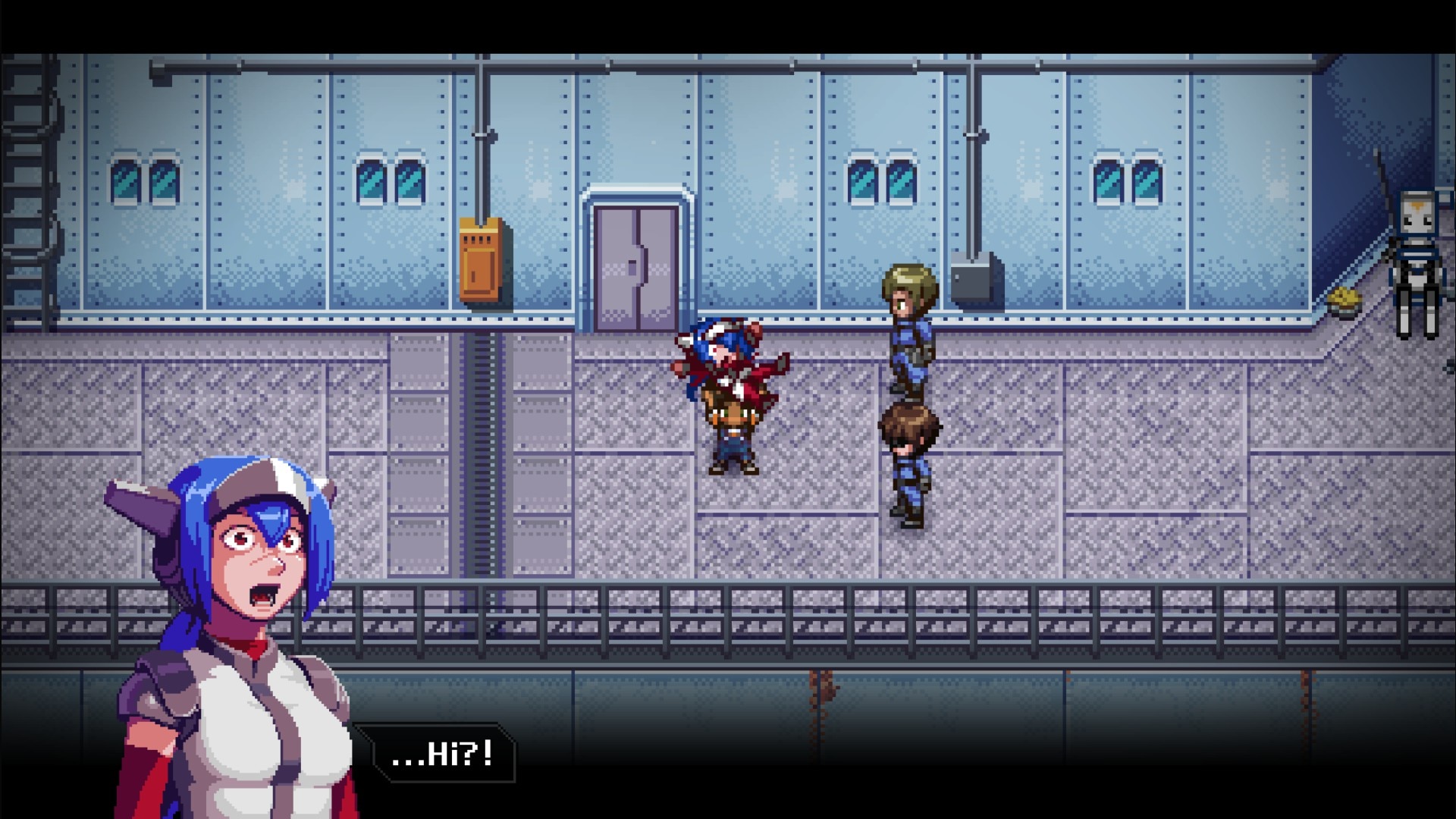
The game also has a sense of humor about itself. Lea, despite being a generally mute character is a very expressive character. She responds with overblown physical comedy and it really goes a long way to accentuate her personality depending on the scene. It also works for scenes when Lea was visibly emotionally shaken. Radicalfish games did an excellent job of finding a way to make you empathize with a silent protagonist.

And man, CrossCode LOVES pop culture references. I basically freaked out when in the very beginning the game when one of the first npc quests parted me by saying Aziz Ansari's big line from the "Steak Night" episode of Scrubs. You find an "Umbrella corp." in one of the cities and you can't enter because of an outbreak they are having. For the Halloween event, you have to collect "Jack's flames" for a character that is CLEARLY Oogie Boogie from Nightmare Before Christmas. I can see from the coming update that there are more character references to be made soon.

Soundtrack is pretty good and it was very fitting for it's overall theme. Described by it's composer of Deniz Akbulut, the CrossCode OST is heavily inspired by Japanese game music of the late 90s using electronic beats, melodic tunes and epic JRPG Scores. This is a fair way to explain it, because the best description I had for it was "Video Gamey" which again, is perfect for it in this case because of the visual styling, story delivery, and accompanying gameplay. There are handful of decent tracks, but I wouldn't consider too many of the 60 to be overly memorable.
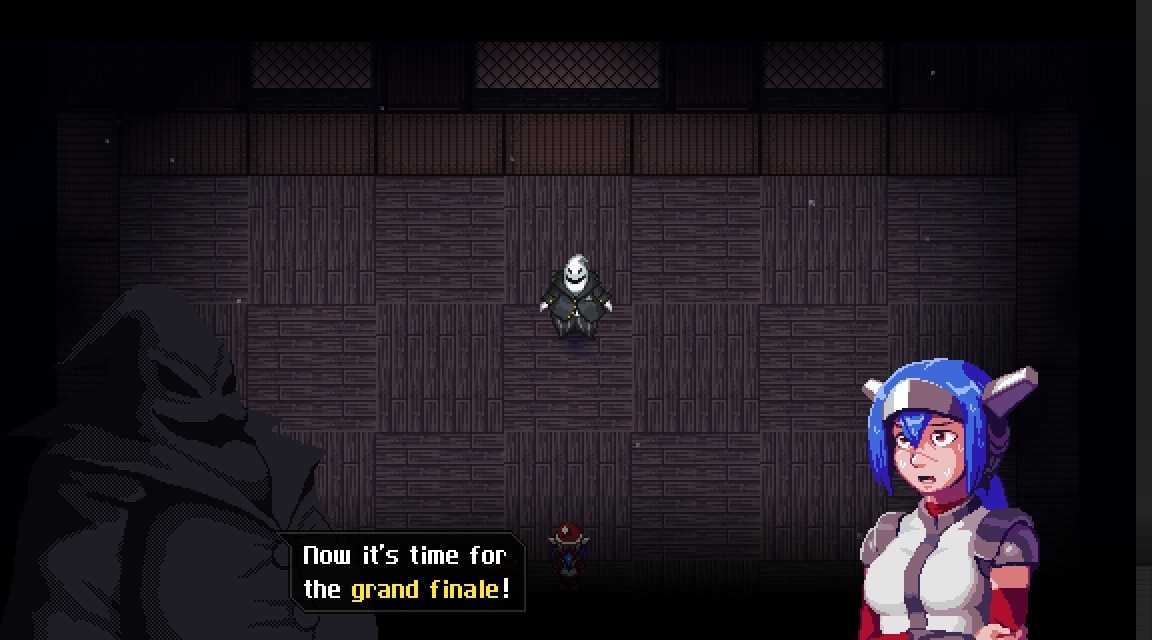
Oh Look. Its Doogie Noogie from A Bad Dream Before Kwanzaa. 
There really isn't a lot I have to complain about on this one that isn't in some way addressed. Like for example, when I complain about this game, I would often comment that these puzzles really do make me feel dumb as hell. It was very rare occurrence that I ever jumped into a room, saw the puzzle, and figured it out at a pretty quick clip. Now you can argue that having a solution guide embedded into the floor design is technically good game design, but there was very little indicating that's what they were doing. There was too little visual cue because I pretty much never noticed it until it was pointed out to me.

I could complain about the combat challenge, but I can only think of one real instance where I actually had to turn the difficulty down on a mob fight just so I could actually complete the quest. there was a pretty significant amount of frustration and trial & error, but outside of the one instance there was no fight that I wasn't eventually able to overcome under my own skill level.

Because the game is framed like an MMO, I could complain that some of the questing is the same MMO grind that bores me when I try to play a game like that, but it didn't bother me in this one. This is probably because the game is not an MMO. There is a story at play here with a defined ending, and because I'm not just killing mobs to open the next mission, I am motivated to continue because I want to see how things unfold.

I loved lightning techs, I used them almost exclusively because I love rapid fire damage.

And without spoiling anything? The ending feels unfinished. I get that this was a kickstarter game and they were probably trying to make a deadline to appease their backers, but it was a mild let down. In my first playthough I got a bad, pretty unsatisfying ending. I come to find out that you have to find a very out of the way NPC to trigger a small quest line which slightly changes the ending, but allows you to open the path to good ending.

Thankfully I could reload my save, so I did so. The ending changed by a few lines and actions, and just as I got ready to proceed further and see where it was going?  Nothing. I was able to go back into my game and do missed quests, but the option to go "to the future" was locked off, because that content isn't there yet. Or at least, it's heavily implied that the content will be added later. So I don't get to see how the story actually ends, and the dangling plot threads are left untied. Ironically, the NPC players are suffering from the same fate, because when you get to Crossworld's final dungeon, they players are all lamenting that it hasn't been included in the game yet. Misery loves company I guess.
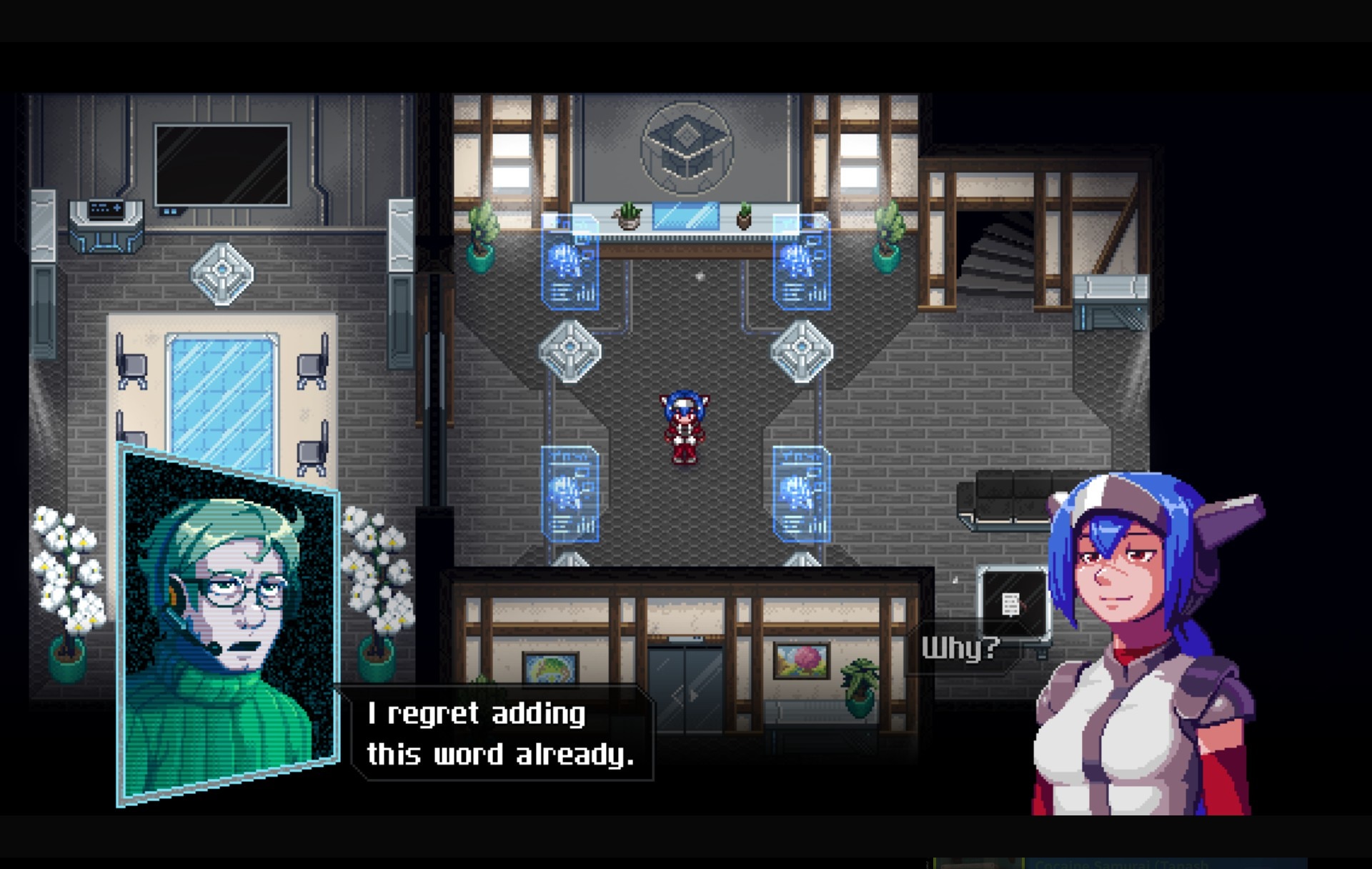
Smug Lea is best Lea.

But my biggest problem is the confusing and somewhat annoying equipment system. See, you an buy equipment in towns, and that is usually enough to keep your gear leveled with you and the area, and that's fine. But you are told that getting item drops to trade for equipment is usually better. This is where the fight combo chain thing I mentioned earlier comes in. But even if you get your combo chain to S-rank and hold it for a long while, it still takes quite a bit of time to get the drops you need for some items. Almost 90% of the time by the time I got the drops I needed for an item it was already outclassed by the new stuff I bought,.

Or, more frustratingly, when it wasn't? It didn't seem like the equipment is actually better. This is a game that has a friggen ton of various bonus effects to each item, so its incredibly hard to outfit your character. It feels like its giving you a lot of room for customization with items, but its so convoluted and confusing I never know if I'm making the right move. Like say I have a weapon that gives me decent stats, but has no effects. Then I find a "better" weapon, it has a brawler stat, and has a status effect, but then it gives me a massive ding to my HP and attack. I'm being told that this is the better weapon, but it never feels like it because they are unbalanced by what is taken away. It was frustrating because it made trying to grind for items feel like an arduous chore that wasn't worth the effort.
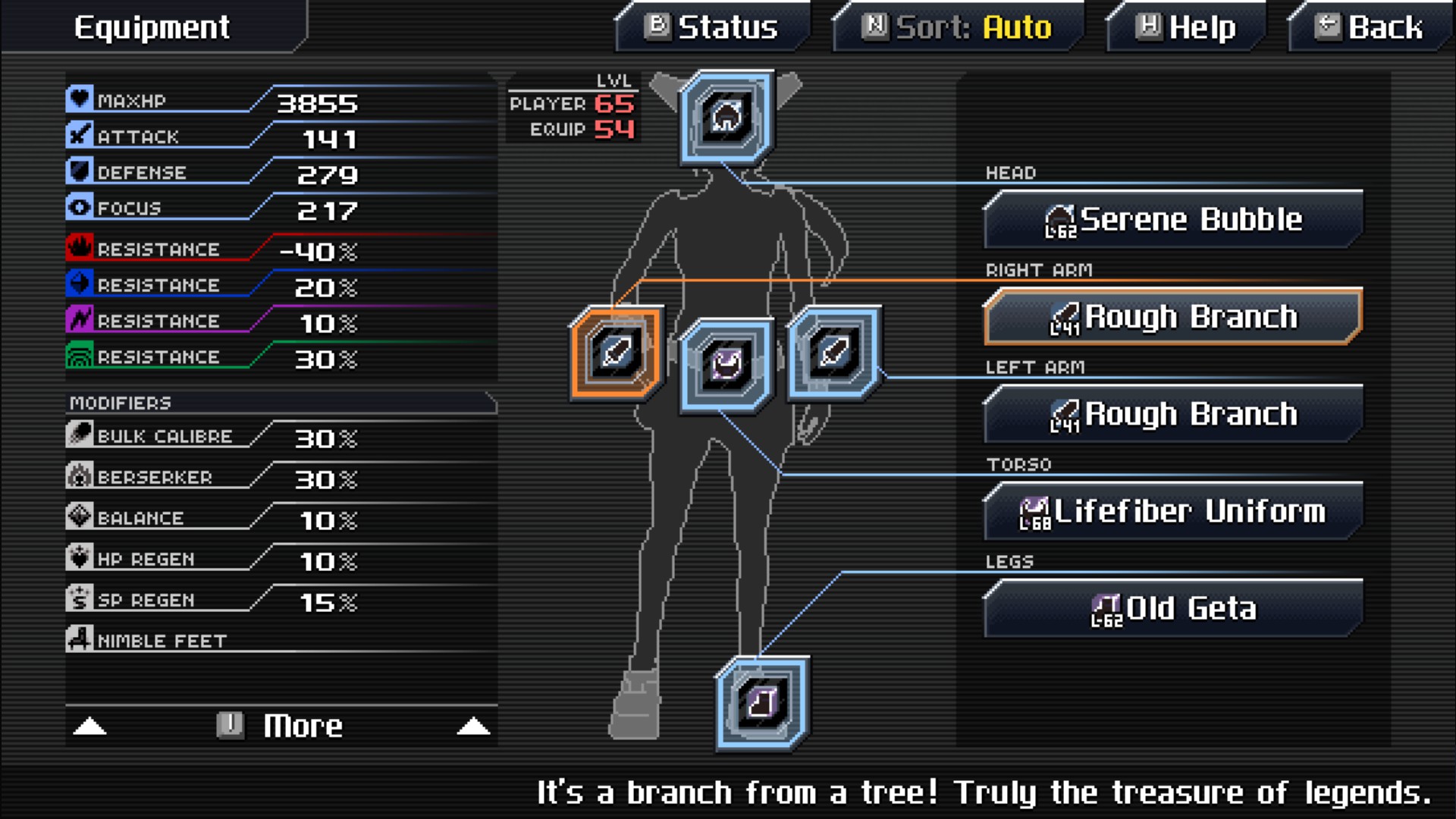
I can only wonder how much faster I could have beaten
 this game if I understood what most of this shit meant.

But its hard for me to complain that much because no matter how many times I put it down, it was a game I kept coming back to no matter what made me put it aside in the first place. Once I really started to understand how the puzzle mechanics work and story really got rolling, I found myself incredibly immersed in this one. I am looking froward to some DLC updates because I really do hope this story continues, because its the only dimmer on this overall solid experience, and even then it was a mild disappointment at best.

CrossCode came out to little fanfare, but its certainly starting to catch the right set of eyes. And now this once PC only experience is about to come to the Switch and the PS4, and that is only a good thing to help this game really get out there. More people should play this game. It's an incredibly solid experience that blends a lot of familiar game elements to make it feel truly unique. It's got a sense of humor about it that keeps it from taking itself too seriously, but also does a good job delivering it's emotional punches of the story. The puzzles are well thought out and clever, the combat is fun and challenging. Its only 20 bucks and is at least a 50-60 hour experience with updates on the way. I can't ask for an better entertainment dollar and give CrossCode a strong recommendation. 


Also, with a code, Lea will idle and do Caramelldansen.
Fucking. Sold. 

Thursday, October 4, 2018

A Hat In Time (Steam): A surprise hat thrown in the ring.

Sometimes there are games that you hear about and just from the couple of sources you trust you know that you are going to want to try it. That was kind of where is was at with this one. I heard the game mentioned a couple of times and I heard some pretty positive reviews about it without reading too much into it.

So naturally when the steam summer comes around I have games like this one locked, loaded, and ready for purchase. It dropped a bit so I jumped on this one. It sat in the backlog for a bit, but while looking for something new to play on my Thursday stream and this seemed like a good change of pace. So with that, we donned our best cap and dove into.....

A HAT IN TIME:(STEAM)


So contrary to what I had assumed, this is not about time traveling girl in a dashing top hat. That's only part of it. Hat Girl, as she is known, is an alien simply flying home in her spaceship. But as she passes over a specific world, a member of their local mafia bangs on her front screen demanding a toll. Hat Girl refuses and the Mafia smashes her window, causing her vault to fly open and suck out these glowing hour glass "time pieces" as well as herself out into space to the planet below.

There, Hat girl meets a local trouble maker in a red hood and a dashing mustache, hilariously called Mustache Girl. Initially, after Hat Girl helps her get free from the Mafia, Mustache Girl agrees to help find the missing time pieces if Hat Girl helps her run the Mafia out of town. Things go well until Mustache girl learns the time pieces can be used to actually alter time, and has the idea to use these to be time traveling heroes and ride the world, and other worlds of their bad guys.

Unfortunately, Hat Girl needs to them to power her ship and get home so she declines. Mustache girl claims this is a selfish use of them, and after stealing from Hat girl and dissolving their friendship, it then becomes a race to see who can collect the time pieces first.


Spoiled a little of the story there to give context, but that is more or less the framework of the story and its as good a motivation as I needed.  As I eluded to in the intro to this one, I basically went into the game pretty much not knowing a thing about. But now that I have played through the game from start to finish, there is only one way I can describe it:  A Hat in Time is a love letter to the 3D Super Mario platfomer. So expect a good number of comparisons to it.

At the onset of the game, Hat Girl has pretty limited bag of tricks. She can run around, and jump, and has a umbrella that she can swing at enemies. When she is airborne and someone comes into range, you can hit the attack button to do kind of a homing flying dive at a baddie. Its a generally invulnerable move but its not fluid or fast. So you will more than likely bash things with your umbrella until you are prompted to use the aerial attack, usually by bosses or specific enemy types.


You have 3 primary objectives every time you drop into a new level. You need to A: collect pons which are gems that will let you unlock new buttons for you hats which give you new passive abilities. B: collect balls of yarn which allow you to unlock new hats, which give you new active abilities like dash, bombs, etc. and C: collect that level's time piece, which allow you to progress to the next chapter of the game. 40 time pieces in total.

As I sort of mentioned before, it draws a great deal from the formula that made Super Mario 64 work so well. Each chapter of the game is broken up into 4 to 8 acts which drop you into that world to go after a new time piece. And like much like its inspiration, each change of act might produce some subtle changes to the level on top of your ultimate goal.  For example, in the first world of Mafia town, the entire place is somewhat of a tropical beach island city.

Man, the Mafia are friggen jerks.

But in one of the acts, Mustache Girl turns on all these giant faucets that basically make them spout out lava instead of water, so now any of the water you could previously swim in now causes damage and require more precise platforming. The goal to unlock the time piece is to navigate around the new terrain to reach said faucets and turn them off. Worlds are generally open so you can explore around and see what changes and learn where you can go now or what ability you might need to come back later.

After completing a certain number of acts (you don't need every time piece) you can move to the finale of the act which usually results with a fun, interesting boss fight and the closing of the story for that set of worlds. All of them individual to each other so while it does lead to a big final story arc, each chapter feels contained and different so they feel different, fresh, and unique.

You can always replay levels to go back to reload on pons or try to get more yarn to get new hats for more abilities. It is entirely possible to beat the game without having all of them because I was able to do so and do so without much difficulty. As you play, you can also find time shifts. Again, much like in the 3D Mario games and would say Mario Sunshine in particular, time shifts are these kinda surreal floating in space pocket levels that usually involves some trickier platforming to complete in basically a wide infinite undersea/spacescape. Most chapters have 2 or 3 of these.


So I'm not gonna lie, There is a lot to love about this game. First off this game bills itself as "A Cute as HECK platformer" and I'm hard pressed to disagree. Everything about the art style gives me a nostalgic Saturday morning cartoon feeling about it. Cartoony style caricature with big eyes and character proportions. A lot of absurdist scenery. Each world has its own differing theme with characters to go with it be it a train car of birds, a forest of ghosts, or a mountain of shamanic goat people. In the recent DLC update, they also added a "retro" mode to make the graphics looks like they are on the N64, and somehow that feels like it fits just as well.

Hat girl, who never actually has a full speaking line I think, has a lot of little character building animations that will happen when she idles or during the course of the story or level. She is a bit of a fun loving prankster and when approaching enemies she stick her tongue out and make a "bleeeeeeeaahh" sound at them. She'll make faces at people and tease. But she is also a sweetheart and if she befriends someone she'll blow kisses that have little hearts. This game is adorable.

In more than one level, she'll have to sneak around silently. During these levels of the game you will notice that if you aren't using your dash, you will see that she is walking around holding up her hand in a finger gun pose like she's playing that she's a spy. It's a lot of these little animations that end up giving Hat Girl so much character to her personality without having to deliver a single line of dialog.


There are some pretty great supporting characters too. My hands down favorite is the antagonist from the 3rd or 4th act, a ghost called the Snatcher. He basically traps you at the start of the level and yanks your soul out, and then forces you into a contract to be his fixer. Everything about this character makes me laugh. His voice, the 4th wall breaking cynicism of his boss fight, he even has brief Undertale reference if you are looking for it.

One character I was expecting more from is the shopkeeper you use to buy new button abilities for your hats. He is a ghostly, spectral character with a floating mask and broken speech. Just from his overall design I expected there to be more story, or content relating to him. He ended up just being a shopkeeper like he said he was, which actually kind of impressed me because that is an awful lot of attention to detail for a character that essentially has no bearing on the story.

Every part of the game with the Snatcher is my favorite part. I love this character.


They throw in a lot of little game mechanics in this one to change the feel of it too. I mentioned the stealth levels that borrow mechanics you might see in a Metal Gear game. In one level you are just racing forward as the stage falls apart around you, using your gear to navigate the jumps properly to keep moving forward, like you might see in Uncharted, Tomb Raider, or even Crash Bandicoot really. At one stage a character wanted me to doctor up my picture for a movie, and so I am basically doing an MS Paint job over my picture as part of an actual story mission. It's hilarious.

Hat In Time also does some camera tricks like Nier: Automata did change the feel of a segment. The game for the most part is generally 3D in all its segments, but one boss encounter with the Mafia Boss, the game sticks a 2D plane for the entirety of the encounter. It limits the range of movement which requires you to have more precise jumping and timing of your aerial attacks to complete. Some of these changes also completely change the tone and feel of the game from level to level.


The game has some very funny writing. It's incredibly cheeky and plays with a lot of the tropes you expect in video games. A lot of segments are very sarcastically written. And while I have called this game a love letter to 3D Mario titles, there is a lot of love to go around as there are references upon references in this game, such as the C.A.W. agents from the Murder Mystery level, which are clearly drawing inspiration from the G-Men from Psychonauts.  There is even a text adventure on the ship that you can play that has some rather hilarious outcomes if you continue to play it. It even turns a trope I generally hate on its head and made it feel hilarious and new, while also providing me a much more difficult moral choice than I was expecting.

Right down to how they deliever their lines, the agents of C.A.W
are a direct parody of the agents in Psychonauts.

This soundtrack completely nails it. This is an OST that sort of does a lot with a little, and ends up giving us a ton. Each stage has their own unique theme, so naturally they all have a complimenting song that go along with them. But as you complete each of the acts in each stage, The song remixes to adjust to the changes of level, thus giving it the song a different feel while still being the same theme for said level.

But then, the game blindsided me with the exceptional rock-as-fuck boss fight themes. I first noticed it with the fight with the Snatcher and its highly covered theme "Your contract has expired". So it caused to me to go back and listen to some of the other encounter themes and almost every one of them is fantastic. I am really loving Contract and "The Battle of Award 42". Pascal Michael Stiefel absolutely knocked it out of the park with this OST. Some of you might be hearing some of these songs in my upcoming Extra Life highlight reel.


The game has a decent length to it as well and what I like about it is that it does not require 100% competition to get through.  It tells you right at the onset that there are 40 time pieces to gather, but you don't actually need all 40 to play through all the main chapters of the game. You DO need most of the hats to navigate through all the levels, but you don't need all of them. This allows for some additional replay value after you have completed the main story. If you wish to do the DLC chapter, it does require a bit more completion than required to finish the game, but I consider that post game content and don't hold it against it.

In addition to all of this, for the first day of its release they gave away the first DLC chapter away for free. While I can never be rid of the bane that is DLC, I appreciate gestures like this. The devs also released an update that provides modding support for fans to customize the game, and a multi player split screen mode that looks to provide some fun cooperative play/teammate trolling as you can hit the other player. I personally haven't had the chance to try the multiplayer, but for collector missions or finding time riffs, this seems like it could be useful.

Awwwww.. These girls...

There are some minor complaints at best. There is a looseness to the controls that 90 percent of the time feels generally feels pretty great when you are playing, but it becomes a massive annoyance when trying to time a jump right at the edge of a ledge. More than once I would be trying to time my jump and go over the edge because I wasn't hitting it as soon as I felt I needed to.

There is an air dash kinda move that you use to extend the length of your jump, which I hate. Not that mechanic doesn't work, but it also functions as your slide move when going down a hill. Again, also fine. The problem comes in is because this animation doesn't cancel itself, or with any of the main actions such as jumping again or swinging your umbrella. So in the occasional tight situation I would be trying to navigate tight platforms, land my extended jump, then die because I was scrambling to swing my umbrella or jump out of the way. It's annoying and seems like an easily fixable issue, and may be with upcoming patches.


As with most 3D games of this nature, there is some camera fuckery that can be a mild aggravation.  When having to do some wall jumping, climbing, or worse yet when you have to land on narrow platforms, you also need to sort of guide your camera while you jump to make sure you stick the landing. It's not exactly fluid and not comfortable to do, so chances are you will be making more than one attempt to hit a jump. This is incredibly frustrating when trying to jump on a clothesline because of the narrow target to hit. The level "The Big Parade" was probably the most frustrating example of this.

This is more of a personal complaint, but I would have liked health to be a little more forgiving. I wouldn't say this game is exceptionally hard, but hearts aren't as common as pons are. Unlike 3D Mario games where you get 8 health and coins restore it, Hat In Time only gives you 4 and only specific heart pickups restore your health. This makes the latter stages, and specifically the DLC update on a WAY higher difficulty curve than the rest of the game, which can lead to some frustration.


But ultimately, these are minor complaints on an all around solidly built game. The fact that this was done by an incredibly small team and basically shared in bits in pieces instead of working together at one office makes it even more impressive to me. A Hat in Time hits all the right points for me for a new property: fun characters, good soundtrack, great replayability, adorable art direction, the right amount of skill to be challenging without being frustrating, and so on.

Sometimes when there is a buzz around a title and you take a cursory glance at it you know that it's going to be right for you, and that is exactly where I put A Hat in Time. This game is appropriate for everyone and has a little something to offer everyone's gaming tastes a bit. I very much enjoyed this game and give it a wholehearted recommendation to anyone who is looking at it.  I just wish that I started it sooner.


Sorry Mustache Girl. But every British sounding
woman just sounds like Tracer to me now.

Tuesday, June 26, 2018

Yakuza 6: Song of Life (PS4) - A retrospective on the series as a whole.

It's baffling to me that I have worked on this blog for as long as I have. As I've told before this blog was started actually as part of a masters course project. Seemed easy enough, start a blog and make a post. I play video games, so why not talk about a game I really liked? That game was Yakuza 4.

Since then it's a pretty winding road for the franchise (originally known as Ryu Ga Gotoku) as a whole. After a lukewarm launch and niche audience, interest in western releases waned for Sega and they basically gave up after the very poorly received zombie offshoot, Yazuka: Dead Souls. Thus began the 3 year fight to try to get Yakuza 5 released to the west. Once that battle was won, they tried again by releasing the prequel game Yakuza 0.

THAT was the game really allowed the tires to dig into the western soil and get some tread going. Now people were at the start of the story, and with the release of the Kiwami games, people are getting to experience the full story now. For those like me, this culminates with today's entry and the newest installment of this long running franchise. I've fallen too far behind to give each game a proper review. So instead while covering this one, I will speak on the franchise as a whole. Be warned: There may be spoilers ahead.

YAKUZA 6: SONG OF LIFE(PS4)


Yakuza 6 picks up mere moments after the ending of Yakuza 5 with longtime protagonist Kazama Kiryu bleeding out and injured in the streets after his last over-the-top battles with the Tojo and Omi when he is found by and finally reunited with Haruka. Haruka after winning a contest to become an idol and had just formed a supergroup with rival group T-Set, had just admitted to a live audience her guardian was former Yakuza, and publicly announced she was quitting the entertainment industry before running out of the Tokyo Dome.

While Kiryu was recovering from his injuries, he was approached by the police about his responsibility to the public damage that was caused with his battles with the Tojo and Omi clans. Instead of fighting back or using connections to get out of jail, he instead opts to do his time, and get out with a clean slate. When he does, he can return to the Sunshine Orphanage with Haruka and live as a family with the children there waiting for him.

But when he finally makes it back, he comes to find out that Haruka has left. She wanted the press and reputation of her ties to Yakuza to not hinder the other children's opportunities. Kiryu returns to Kamurocho to try to pick up her trail, only to find she is comatose from a hit an run accident and that she apparently had a son. With only a trace amount of leads, Kiryu takes the child and heads out to search Kamurocho and Hiroshima to find the alleged father of the baby and to find out who hurt Haruka and why?


As you saw in the last year end wrap up, I showered a little praise on both Yakuza 0 & Yakuza Kiwami for being standards of excellence in gaming. I have played nearly all of them available to me at this point, and outside of Yakuza: Dead Souls (a non-cannon offshoot, mind you) almost all of them rank equally in how they are built. Primarily because despite being a long running series, there really isn't a lot that changes in the core formula of a Yakuza game. It's the main reason most of them haven't gotten full reviews.

When you first look at screens and game play footage, you would assume its in that open world vein that you may expect Grand Theft Auto to fall under. And while to a small extent this is true for a basic framework for missions, this really isn't at all how the Yakuza franchise plays. It's more of a blend of sandbox, beat em up, and rpg if I had to narrow it down. As you walk around town you cant just start creating mayhem (because Kiryu is an honorable criminal?) and start smashing people. In this series combat appeared almost like random battles with thugs coming up with laughably obscure reasons to attack you. In Yakuza 6 this was made a bit more seamless by skipping the dialog to make it feel more natural.


The combat of the Yakuza franchise is really the bread and butter and this is why you play. It's a variant of the standard 3rd person action game and typically sticks to a light attack, heavy attack, grab/weapon, dodge convention. It can lend to button mashing if that is your style of play, but it goes to great pains to show you all the various combos and heat moves you can unlock that really can open up your strategy when you play. It's primary selling point is the heat mechanic: As you deal damage to enemies you raise a heat bar, and once it reaches capacity you would be surrounded by a flame like aura. When in the right situation, you will be prompted with a heavy attack prompt that will go into a brief but visceral animation of your character dispatching an enemy in brutal fashion. These are the heat moves and they are hard to watch at first but oh... so satisfying.

And there are TONS of ways to do these moves and they change by what you are standing by, what character you are using, what weapon you are holding, what stance you are in, if your heat gauge is full to certain levels. Its almost like a puzzle game itself to try to find and perform all of them, and its actually rewarded because the Yakuza games tend to be known for 100% completion excess.

Heat move from Yakuza Kiwami

The fighting styles in this game are also generally the same across the board but there are instances in which it does change where it makes sense. Typically the fighting style changes when you are playing different characters, and that works because naturally each character would fight differently. Seijima, a character from Yakuza 4, is a burly beast of a man so naturally his fighting style are big hulking swings and smashing heavy weapons to Kiryu's straight forward aggressive striking style. Akiyama is known for being suave and deceptive, so he uses a fighting style that employs kicks and tricky moves.

The times where this didn't happen for example are in Yakuza 0 & Kiwami respectively. Which almost make sense where this is the beginning of the timeline. Kiryu and Majima are still cutting their teeth in the yakuza so they actually employ 3 fighting styles you can change between as they develop their signature style. Since they are the only characters in those games, this mechanic works because it allows variance to the game play without forcing the game to take the narrative off the primary characters.

Combat suffered a little bit in Yakuza 6 because with the step up to PS4 hardware caused a step up in graphical display and game performance, and I feel to make time for all the rendering the move set was cut back a bit. It was still fun to do and visceral as ever, but it certainly felt lacking in comparison the rest of the series as a whole. The bottom line though is for skill, quick paced combat with a weighty feel to it? The Yakuza franchise nails it on that front.


Another trait that this series is known for is the straight jacket wearing level of distraction this game provides. See, the focus of these games is the primary narrative which sometimes can be a little bit samey. But in between the major story moments of the game, you get explore the streets of Kamurocho. This is actually a fun little recreation of actual Toyko red light district Kabukicho. And it features all the distractions you might expect from a downtown district of Tokyo: streets filled with restaurants, arcade games, gambling parlors, hostess clubs, night clubs, stores and filled with actual Yakuza members.

In this specific series of games, almost all of these are interactable, like an inception of games. Sega has on more than one occasion put in older games within Yakuza.  So I would stop my progress in the game so I can play Taiko Drum Master, Virtua Fighter, or Out run. Sometimes there are side quests with random NPCs involved with these, but 90% of the time they are thrown in there as just extra bullshit to play with while you do. You might think why would you put in there then if it doesn't mean anything, but I can't tell you how easy it is to sunk into other game instead of moving on. The number of distractions only increased with each installment of the game (Yakuza 5 had so much side shit they could be sold as separate games) before finally dialing back some in Yakuza 6.


As mentioned prior there is a fair amount of side questing to do. A lot of the times this will just involve you having to go to a place and beat somebody up, but a lot of these are a way to introduce some of the mini games. Most of these provide experience bonuses to level your character faster, and some of them will unlock item rewards. None of them are required to actually beat the game but the experience helps as bosses will force you to get more skillful in your fighting.

Although some are really fucking out of place. Most egregiously, and I've talked about this before, is the required hostess club missions in Yakuza 4. In a game where I am suplexing someone onto a bike rail and them smashing his friend with the actual bike, being forced to stop so I can play Pretty Pretty Princess THREE TIMES is incredibly jarring and unnecessary. One time made sense for story context, three times was just ridiculous and excessive. But if you wanted to get the completion, you had to do this with like six girls. No thank you.

I'm not kidding. In the midst of the story of crime, betrayal, and honor you
need to take 3 breaks to make sure your hostess fashion is up to snuff.

Or like in Yakuza Kiwami, I'm being constantly hounded and mugged by Majima, but then suddenly he stops because he feels he needs to be better than me at pocket cart racing. What?! Perhaps this is a way of leading horse to water as it were for getting the player to notice and try these mini games, but honestly in the game that lets you go out and explore what there is it see, I can't image there is much a need to make the player try them. A friend I recently turned on to the series told me she couldn't progress with the story because she was enjoying the side questing too much. So yeah, not a big problem on that front.

From a graphics perspective, the Yakuza franchise made some strides when going from the PS2 to the PS3, and from that point on has remained incredibly consistent on that front. Once they had down their design in Yakuza 3, the character appearance never really changed. They just continued to overhaul and tweak it's visual design to where we are now with Yakuza 6 where all the textures have damn near photo realistic skin imperfections and lifelike glisten to sweat and tears. I found myself on more than one occasion marveling at how good the series has come to look.

Actually, looking at it now Yakuza 1's graphics really laid the foundation well.


There has to be a degree of motion capture as well because the most recent iteration of this game featured a number of NJPW wrestlers and Kiryu had busted out more than one pro wrestling move into his new arsenal on more than on occasion. But more so than that is this is the first time I recognized a character as an actual personality as one of the primary characters in Yakuza 6 was famed Japanese actor Takeshi Kintao who you may know from the new Ghost in the Shell movie, The Blind Swordsman, and probably most famously Battle Royale.

Additionally, the Yakuza games are somewhat of a fun time capsule for this depiction of contemporary Tokyo. with Yakuza 0 it starts off in the 80's where outfits are garish, technology is dated, and clubs had very different visual stylings to them. And as you play through the series you always stay in, or wind up coming back to Kamurocho. Kind of like Nier:Automata you could argue that by reusing the same map it feels cut and paste, but really I always feel nostalgic and familiar with the streets, and enjoying finding what stayed and what changed.

Majima's "Breaker Style" from Yakuza 0

This series soundtrack tends to be fairly complimentary as well. 90% of the time you probably wont even notice the OST as much of it shifts from droning overbearing ambiance for it's dramatic moments, and a hard rock bed during fight sequences. You will notice more iconic sounding theme in the bigger moments of the game where you have long drawn out action sequences, and each game usually has some big main theme that goes down during the fight sequences of the game. Yakuza 4's "for faith" for all 4 final boss sequences is still hands down the best. In each game only a few tracks will truly stand out, but all of these OSTs are ones you can toss on a playlist and get lost in while you do stuff around the house.

But most importantly of all for the Yakuza franchise, is that if there is any one selling point above all else is that this game has some truly exceptional story telling. Throughout the series and primarily in the early stages of the franchise, the narrative is based around Kazama Kiryu and Haruka Sawamura. Despite being in and out with the yakuza, Kiryu is still a pretty predominant figure in it's politics and despite his best efforts seems to constantly drawn into the fold be it power struggles, murders, or turf wars.

Much like the setting the game takes place in, I love the dedication to the development times of the games in correlation to the characters. This isn't as notable with most of the cast but is primarily noticed with Haruka. When you first meet her in Yakuza 1/Kiwami is only 9 years old. By the time you see her in Yakuza 6 she is almost 20. When you look at the development times of the games, she is always aged just as old as you saw her from the last game release over the course of the entire franchise. You basically get to see her grow from child to adult through the series. Resident Evil 6 did this with Sherry Birkin, and that is a chronology continuity I have always appreciated seeing when it comes to storytelling.

Haruka: Age 9 as of Yakuza: Kiwami
Haruka: Age 18 as of Yakuza 5

Yakuza 4 set off as a branching point where we started to deviating from Kiryu as the primary focus, introducing us to a wave of new characters and stories to follow before branching back to our stalwart hero. With new characters allowed to take the stage, we are now starting to see a bigger focus on new fan favorites like Akimaya and Seijima in 4 and 5, and Majima in 0, Dead Souls, and the upcoming Kiwami 2 remake. So while Yakuza 6 marks the end of the Kiryu arc, there is plenty of people who could carry the story if need be. But not Tanimura, that character basically vanished after having a lead role in Yakuza 4.

Ultimately though, this series is crime drama through and through. So despite reasonably stable starting off points for the story (usually a murder), there will be so many twists and turns during the course of the story, that you will never really know what to expect by the end of it and some of it can be pretty ridiculous. Well, that's not entirely true. When talking to a friend, I described what I call my "Shirts off, Shit's Serious" rule. You always know when a fight is important contextually, because MAN do the dudes in Yakuza love to rip their shirts off to show off their bitchin' ink jobs on their back.  When you see guys ripping off their shirts and jackets in one seamless transition, you know things are about to go down in a big way (this is extremely hilarious in 4, where 8 people do it in one segment).


There are a small handful of complaints I can make. Like I mentioned before, fights in these games almost have a very Final Fantasy random battle feel about them, as people stop you on the street to make some ridiculous commentary about why they are going to kick your ass before having a fade transition to the battle sequence. This was worked out in the newer games, but it certainly can affect the pacing in some of the earlier ones. Although I have to admit I loved some of the sillier reasons people would fight me.

If you are a player who is obsessed with 100% completion, best of luck to you because this game fucking counts everything. Fighting styles, scores in arcade games, money won in all casino games, eaten every one of the food items in the 100's of restaurants, dated all the hostesses, and on and on and on. My first play through of  Yakuza 4 I want to say ended with just under 90 hours of game play. By the time I was all said and done with it, the game told me I had just under 25% complete. That is literally insane. Its even harder with some like Yakuza 0 where you have to buy properties to complete that quest, but the game or map doesn't actually tell you which you bought or which you own.

I mean if Akiyama was courting me, I'd have full hearts too.
Dat Mauve blazer. *swoon*
It definitely suffers from the tropes of Japanese story telling sometimes. When watching cut-scenes of conversations they tend to repeat a lot of the same things they said to each other while pausing for effect or making confused sound effects. You will always have some low level shouty grunt losing their shit over the smallest perceived slight, and the antagonists in these series are usually so cartoonishly evil you can basically pick them out the moment you see them for the first time.

Also if you are like me and not starting with the actual beginning of the storyline (I started at 4), the beginnings of all these games are going to be confusing as hell because they will make reference to characters, clans, locations, and events that tie to the previous games. While it is confusing, once you learn the major players specific to the title and what the main plot of the game is, the back story isn't as necessary as you can focus on who you do know. It will all eventually tie together.


And this is somewhat of a personal gripe but if you are going to give a me a karaoke minigame to play, why would you only provide two songs? This is something that is consistent in like every one of these games and I have no idea why. The dual layered blu-ray disc is huge. I'm not saying pull a whole tracklist of DDR in there, but I don't think 5 or 10 total songs is asking a lot. You expect me to play them more than once if I'm doing the hostess club dating, some song options would help that.

It also will throw you to the wolves with some more traditional Japanese gambling too. Most of the games you might recognize from a usual casino, some you might recognize but not know how to play like majong or pachinko. But some of these games can be very, very culturally unique and require a lot of re-reading of the rules to go back to even get a loose idea of how to play it. I've played Majong for like 12 hours and I still don't eff'n understand that game.

Was this good? I HAVE NO IDEA WHAT I'M DOING.

Lastly, and my biggest complaint: where the fuck is Yakuza Ishin!? Done in the same mechanics of the traditional series, it is a set period piece where the characters are used in historical japan. Basically the same kind of game only with samurai instead of gangsters and swords instead of fists. I've seen trailers and gameplay and this game looks fucking fun as hell, but because its knee deep in Japanese history they won't localize it because they don't think Americans would understand it. Bitch, we love Kung Fu movies, Anime, and now have a burgeoning K-pop community. How about you let us decide what we do or don't want. Thankfully, with the sudden growing success of the series, the hard no they were giving us about localizing it seems to have changed to a maybe. I have a small hope.

I really don't know what else I can say about this franchise other than its one of the best series I've ever played. None of them are perfect, but I love these characters, I love this universe, I love the music they use, I love the mind numbing amount of distraction, I love the brutally visceral combat, I love the drama, I love the idea of smashing a bicycle over a thugs head before smashing his friend with one of the wheels. I love that you fist fight a fucking bear. I love the Yakuza games.

You can read this review and apply basically everything I've said to any of them. I think they are all great and if slathering this series with praise isn't enough for you to give one a shot, then I don't know what else I can do. With the resurgence this series has been getting, we are getting a Kiwami 2 remake and remasters of the remaining titles on the PS4 so you have no excuse, because they will all be available in one place. Pick any of them, it won't steer you wrong.


Except Yakuza: Dead Souls. Don't pick that one.

Saturday, March 3, 2018

Bravely Second: End Layer (3DS): Grinding down.

When this first one came out, I quite literally dove into buying a new handheld to try it because I knew I had some long flights and a convention to spend time with it. In my review I had more than my share of nitpicks but ultimately I left it saying that I hoped that this would be come a franchise and hoped that this would have a nice linage behind it.

Well sure enough this series did get a sequel in April of 2016. And while I was enjoying it, I eventually set it down and moved on to other games. But after working through my pile I did go back to grind out and finish. So while the game has been out for a while, I got my thoughts on it now. 

BRAVELY SECOND: END LAYER (3DS)


Bravely Second picks up two and half years after the events of the first game. Agnes for her work as a crystal vestal has become a Pope in the crystal orthodoxy and is currently brokering a peace treaty with Braev Lee, the duke of Eternia. Just as they are about to sign the accords, they are interrupted by Kaiser Oblivion.

The attack is devastating and Agnes is taken hostage and brought to the Kaiser's floating sky fortress. Yew Geneolgia is the leader of Agnes personal security detail, the Crystalgard (and our primary protagonist for this game), and looks to rally his allies and the remaining orthodoxy forces to try to take the fight to the skyhold and bring Agnes back.

The game starts pretty much in battle, which is a great way to get JRPGs going

Obviously, the story of Bravely Second is more complex than that but after we pass where I've mentioned we get into spoiler territory very quickly. I will say that this time around the story is a bit more involved and fleshed out and the previous iteration. Bravely Default was by no means a simple story line but its basis was you need to restore the 4 crystals, and if you played the previous title then you know you did that a lot.

Bravely Second follows a more traditional damsel in distress trope where Yew rallies heroes to give pursuit to a new threat. And along that path there are twists and turns, old faces and new appear along the way. It does make you replay certain segments like the last one did which is something I still found annoying, but not the same amount of times so I won't ding it too hard for that.

This is probably going to end up being a shorter review than my usual shtick because this game is a pretty stone for stone copy of the original Bravely Default, so I would basically be repeating a lot of what I said in my previous review. Much like I said before, the Bravely series is basically a classic Final Fantasy JRPG in all but name: A 60+ hour fantasy adventure with turn based combat, random encounters and exceptional music. Since this is a direct sequel, many of the characters, enemies, and bosses return to reprise their roles.

Agnes is not a primary party member this time, but she is a relevant part of the story.

But it wouldn't be a sequel if they didn't add something new to switch up the palette, so with a new set of characters naturally we get a new set of bosses. And with new bosses we get a new set of job classes to use (called Asterisks in game). Twelve new jobs in all which gives you a pretty mind bending amount of variety to what your party can do. Some of them are pretty straight forward which just allow you to plow with damaging abilities, some of them are a bit more bizarre like the Patissier which requires using items to use the special abilities. Then you get some that make old ones irrelevant like the Bishop, which basically can do everything the White Mage does but to the whole party making it vastly superior.

What I always loved about how they implement the job system in this one is you have the ability to really play around with what skills you have to min/max your characters abilities. In the late game I was basically combo the right sets of jobs and abilities to make a very damaging spell attack all the enemies up to 4 times in a row and sometimes cast twice in a single turn, basically allowing me to just rain down offense in the returning Brave/Default system. Or you could go the classic route like I did in the first game and equip a ninja with as many weapons as they can hold and charge 4 attacks in a row. There are lots of viable ways to play.


Generally the combat system hasn't changed from the previous game, but the Brave Points from the old game are now Sleep Points which are used to trigger the Bravely Second ability. What this does is expends one of these point to allow one of your characters to have a free turn to use up to 4 abilities. You have to have the available turns to spend to do them still, but the benefit is that the damage limiters are removed, so if properly set up, you can unload with an attack that can reach the millions in damage. SP however can only be charged up when you 3DS is in sleep mode, so use them sparingly or you have to spend real money to buy SP drinks. Honestly I almost never needed to use this sans one story moment.

Outside of that, really there isn't a lot of change between the two games on a mechanical level. It uses the same world map, a lot of the same dungeons that appeared in the previous game, you fight a lot of the same bosses and monsters. The "build a town" with street pass mechanic returns more or less the same way (although you can fight optional bosses from other players this time around). You could say that this game basically is more of an extension or an epilogue to Bravely Default than it is a true sequel.

Bravely Second's soundtrack is pretty good as well on top of being fully voice acted. There are lots of little cutscenes and character interactions that help flesh out the story and almost all of them were fun to listen to. The only downfall to the music is that my favorite tracks that played in this one were just songs from the first game.


While all of the characters from the previous game make a return in some fashion in Bravely Second, many of them take a back seat to new protagonists Yew and Magnolia arch. The two major plots basically revolve around these two characters: Yew's mission to rescue Agnes, and Magnolia's mission to save the Moon and defeat the massive monsters (Baals) currently attacking the planet. Basically Ringabel is the only character we kinda lose between games and good riddance. I hate the amnesiac trope.

But whats nice is that even though the old characters return, it focuses on the new characters story with the returning characters as more of a supplement. I like this better because this is what allows the universe to expand and become more interesting. The Atelier games are excellent at this because when an old character drops in, They feel like a welcome Easter egg, and doesn't affect how I feel about them from the previous game.

I think there was another controversy about censoring the girls costumes again,
Honesty guys, if a little cleavage on 3DS pixels being taken away ruins your
experience of the game? You might be picking the wrong hill to die on.

What I didn't like is the flippin' tedium that the Bravely series has now become known for. If you are truly going to play this game in its full capacity, you are expected to grind all your characters up to the max level, and go through and max out all of their job classes if you want to have the right set of abilities to really go up against the tougher bosses in the game. And sorry, even with the fast forwarding mechanics grinding is still grinding. And grinding is boring. It's the problem I always have in the Disgaea games. If you are making a boss so overpowered that its going to take me 100+ hours of grind to stand a chance, I will sooner just not do it.

Which ultimately brings me to the biggest problem that I had in Bravely Second: the game was just too easy to put down and stop playing. As you can see from the date I listed in the intro, I basically played through this game over the course of two years. I would reach a point where I didn't want to waste time grinding so I could fight and had other games to play, so I would set the DS down and literally forget about the game for months on end. That says to me the story wasn't compelling enough to keep me bolted down with the game.


When raining down with 4 meteors on one turn rips baddies a sunder. But you really
need to use the right skills, or Magic can be some of the weakest attacks in the game.

I will say that the grinding aid features such as fast-forwarding the battles and being able to turn off all the random encounters makes a welcome return and honestly I don't know why every JRPG doesn't do this. I suppose it does make final dungeons that much easier, but it also takes out the path of attrition its supposed to be for the climatic final battle. Honestly, if I am grinded out to max level, I turn off random battles and never look back.

The other thing I could talk about is how the ending of the game played out. There really is no way to explain it without spoiling it to a degree, but it does the same kinda thing Undertale did when it played around with the medium and actually addresses the player and not the characters. Technically, if you go by release dates Bravely Second did it first, but only by a few months so they were in the same dev cycle, but I will say Undertale did it better. Both great though, I love how games are starting to mess with the medium to tell their story.

Edea Lee is still best girl. Love her to death.

I did ultimately like Bravely Second but the problem between the two iterations is that Bravely Default was a fresh breath of a new IP done to homage the classic style JRPG. Bravely Second is just more of Default. As said above, it's essentially a long epilogue. They are not going be caught in the Final Fantasy catch 22: Do you change things to try to make it feel new? Or do you stick with the formula and put out a samey release? They honestly can't win either way they go with it.

That being said. I'm not unhappy with my purchase of Bravely Second. It is what it is, more of this franchise. If they make a third one I'll be getting it. But I wouldn't be surprised to see the series end here. Who knows, maybe they'll make a fancy new one for the Switch?


Lol, Baal Buster. Best job class ever.

Tuesday, August 22, 2017

Kindergarden (Steam): School is still rough.

I tend to pretty savvy when it comes to video game releases. As you can tell from this very blog if you have actually read some of it, you would know that I haven't had a whole lot to rage about because apparently I know what I like. So rarely when I take a flyer on something does it bite me on the ass (*coughNightsOfAzurecough*). But I am not one to ignore recommendations either from sources I trust. It's basically how I found Undertale.

One of those sources is the Game Theorists' MatPat. He can be a polarizing figure on youtube, but I genuinely love his work. So when he said on a recent GT Live that this game is one of the best games to come out of 2017, that made me turn my head because were in July (at time of statement) and we already have like 5 Game of the Year candidates already. I fired up steam and saw the inexpensive price and decided why not take a shot on this one. 

KINDERGARTEN(PC)

What makes Kindergarten clever is that the narrative of the game is constructed over the individual stories of the characters. The primary arc of the story is that you are are young kindergartner in a very Groundhog Day situation where you are perpetually reliving monday morning as a bright eyed child out for another fun day in kindergarten class.

But as you play through, you learn the stories of the various children and learn that many of them revolve around one of the students, Lily, and how her brother has recently gone missing. In order to learn everything that has happened and to learn all of the games secrets, you need to properly befriend everyone by the end of the school day.

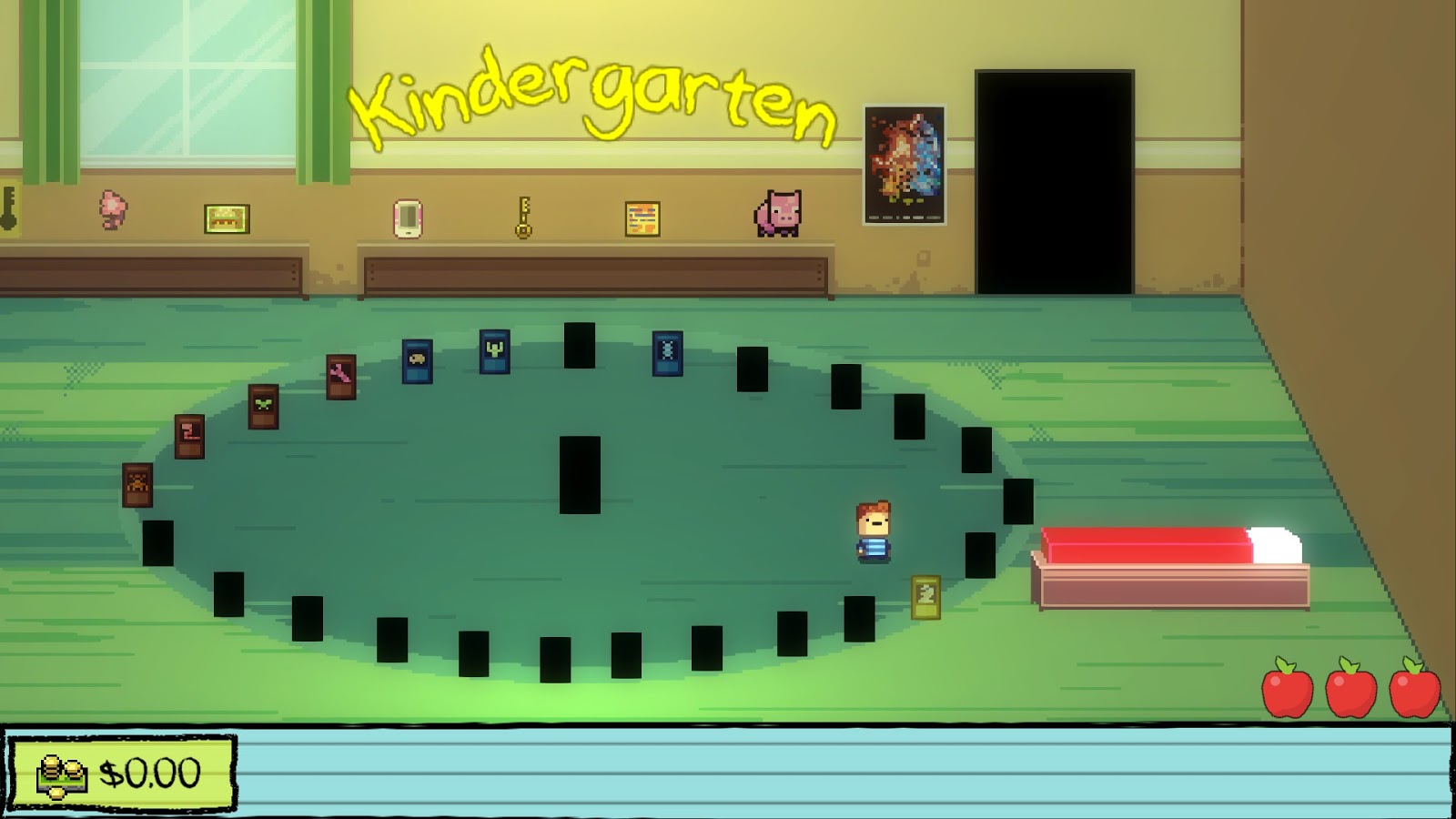
At the start of the day you can bring items or money you have earned,
as well as admire you Monstermon card collection.

And that's really it. There is not a lot of really introductory story to really explain things more than that. You learn from Lily in the very first school segment about her brother so that is not exactly spoilery, and you learn from each of the children right off the bat exactly what character archetype they are. But it really give you a proper setup of what kind of experience this is, it would basically be easier to explain what happened in my very first play through.

It was time to wake up and go to school. I didn't have any money in my piggy bank nor did I have any Monstermon cards. So without much to do I left my house and went to class. I said hello to Cindy, who asked me to her boyfriend, but told me off when I wouldn't put gum in Lily's hair. I tried to talk to Jerome, but he doesn't think I'm cool enough. After getting some weird pill from Nugget, I started to bother janitor. He didn't take to kindly to me sassing him, and warned me that if I didn't skedaddle, he would wipe up my blood with his mop. I called his bluff, and he proceeded to bludgeon me to death with his mop handle. 


Well then, THAT caught me off guard.  Yes, the world of Kindergarten is not just a playful romp with other children ending with show and tell. No, Kindergarten has a very very dark sense of humor about it and there a lot, and I mean A LOT of ways for you to get killed during the course of this game. It's actually pretty hilarious.

If I had to summarize how game play actually worked, I would say that it is very reminiscent of how old adventure games used to work, but a much more stripped down version of it. Think of it if they took old LucasArts games like Monkey Island or Maniac Mansion and stripped down the majority of the actions down to conversation options, and only item prompts when you have something you can use in the situation. It is very simple.


Navigation is easy too whether you are using either the controller or keyboard. Keyboard actually uses both arrows and WASD controls to move, and shift, enter, or space all function as a confirm button. The mouse click also works as well. They keep things simple in that you can only interact with certain objects, and they will always be marked with an exclamation point to signify that this is something you can interact with.

The rub is you only have a limited number of major actions that you can do. After you leave home for the morning, your day in Kindergarten is broken up into 5 segments: schoolyard, class, lunch, recess, and show and tell. During these periods you have 5 apples in the bottom of your screen to signify the major actions that you can perform during the course of that period. So while you can talk to and interact with most things, to make moves on the story you need be selective on what you will take, sell, use, or who you will talk to. You can also spend these apples to earn .25 cents for each that you don't use. 

It takes a very careful approach to deal with Cindy....

So your objective when you start a new Monday (and it is always Monday) is to decide what character you want to follow through on the story on, and try to decipher what items and actions you need to see it through to completion. Some of them can be done going to school with nothing. Some of them require money or items from other completed stories to finish.

There is also a collectible objective as well, as you play through the game you will find or earn Monstermon cards throughout the day. Some are hidden in plain sight, some require a puzzle to solve, some need an item, some are gotten from other characters, and etc.

As you play through the game and collected cards and talk to people through the various conversational options, you will unlock hints that can be accessed through the games menu. These hints can tell you tidbits of how or what you need to solve a specific character's objective to friend them at the end of the day, or the locations and how to get Monstermon cards you don't have. Some of the hints are more helpful than others because I haven't collected everything yet.


Kindergarten is not a very long game, to be sure. I think a cycle of like 24 Mondays I managed to get through all of the individual character stories and saw what I guess you could consider to be the "ending" of the game?  But from what I've read from other players, there is also an additional hidden ending if you can collect all the Monstermon cards. So it looks like there is still stuff for me to do.

Normally in these reviews I discuss the graphics or music but there isn't terribly much to say. It uses some simple but fluid sprite work that manages to look alive and rhythmic, but there isn't a whole lot of motion happening during scenes aside from a little walking. It's always a little funny when a death animation comes out of nowhere.

There is only like 3 or 4 songs in the whole game, and they make for decent background music I suppose but it's nothing I would catch myself humming. The title screen song, a game song, end of day and death jingles, and song for end of the game. So I suppose the longer it takes you to play the more grating it might get. It's a perfectly serviceable soundtrack for the length of the game.

I mean... We were all thinking it. The janitor just said it out loud.

I suppose I could complain about how much text you have to skip through as you play through the game, but that would be a foolish complaint since the game is 100% narrative based. I wouldn't say it's as dense as a visual novel but if you make mistakes through a run, that means you have to go through all the text over again, and sometimes that can be tiresome.

This doesn't feel like a game though that is going to have a lot of staying power after you have played through the majority of the stories. Because to go back and complete others you might have to go through the same dialogue options you have already read multiple times by the end of the game. Once you hit that point Kindergarten does admittedly lose a little bit of its fun factor. I only have a few more cards to get and I find myself lacking motivation to bumble through a lot of these same text options again.


But I can't really complain about the length of the game or difficulty, because the price of this game on steam is only a scant 4.99. So the fact that I got more than a few evenings of streaming and entertainment out of the game certainly says I got way more than paid for on this one. So any complaint that I have is a nitpick and really doesn't sullen the experience for me.

The fact that I only paid 5 bucks for the game and got at least well over 10 hours of entertainment for it says that it was a worthwhile purchase in my book. So if enjoy low stress decision based adventure games that don't require the tedium of excessive menus and options , Kindergarten is certainly worth a play in book. It's only a couple of bucks and it's pretty damn funny. It's certainly different from a lot of the stuff I've played on steam, so I'd give this a recommendation.


Seriously Cindy, what kind of home situation do you have?
Dial it back a notch.